By Annette Licitra
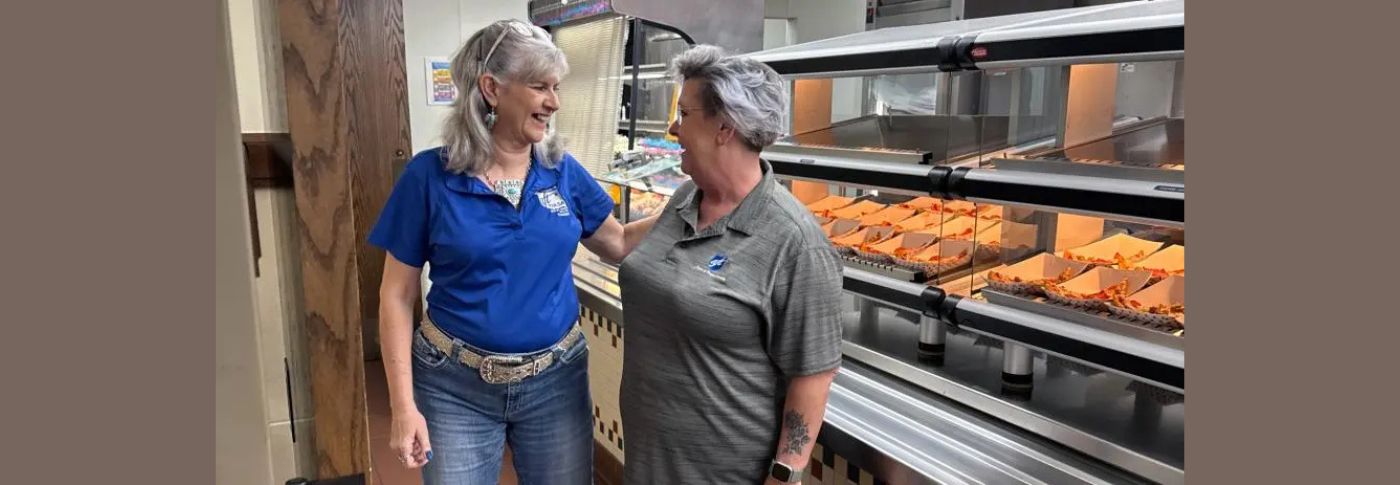
They call it their two-year adventure, and it does seem more like a psychological thriller than a story about school meals. Either way, AFT Tulsa President Nancy Leonard, together with Ginnie Holly, a certified dual site cafeteria manager for the Tulsa, Okla., public schools, used their wits to overcome a corporation and its disgusting food.
Holly watched in growing horror as she worked in the cafeteria for almost 10 years, starting as a café assistant, then as a cook and a manager at Will Rogers College Middle and High School. First, she had to deal with a giant company called Sodexo, which the school district had been using for a long time but whose representatives didn’t listen to what school employees had to say.
Then in 2024, after the district replaced Sodexo with another corporate giant called Aramark, Holly and Leonard decided to speak out.
“There were a bunch of us who said ‘Nuh-uh, we’re going to get smart!’” Holly declares. From the start, Aramark’s manager was “just atrocious and was union-busting on the side.”
What the company was supposed to be doing was procuring food, preparing state-approved menus and creating tasty and nutritious recipes for school meals. What it actually did was deliver spoiled food, including sour curdled milk that poured out in chunks, as reported by students and documented by a local newspaper.
One company manager verbally abused the cafeteria staff, Holly says, describing her as “rude and condescending, hateful and short” in speaking to certain food service workers. This manager also wrecked a school district vehicle and tried to hide it from the district. And a company chef called the staff “little bitches,” while a company salesman insulted the cafeteria employees during a school board meeting, prompting about a dozen of them to walk out.
Amazingly, the school board rehired Aramark for another year, which just ended. By that time, AFT Tulsa had a box full of email correspondence documenting problems with Aramark’s low-quality menu choices, recipes and food, says Holly, who also is a member of the Central Oklahoma Labor Federation.
“At that point, more cafeteria managers joined in and started using their union voices” to spell out exactly what Oklahoma and the federal government require for school meals, Holly says. For her part, she had gained enough confidence by the summer of 2025 to search online and pull up a school report documenting the district’s problems with Aramark. She also found lawsuits (too many to list) against Aramark nationwide.
This prodded the district’s chief operating officer to start a conversation among school café managers, school administrators and Aramark—sometimes in-person and sometimes on Zoom. Documentation by AFT Tulsa lasted through the 2025-26 school year to hold the company accountable for its service, Holly says.