. Skip to main content
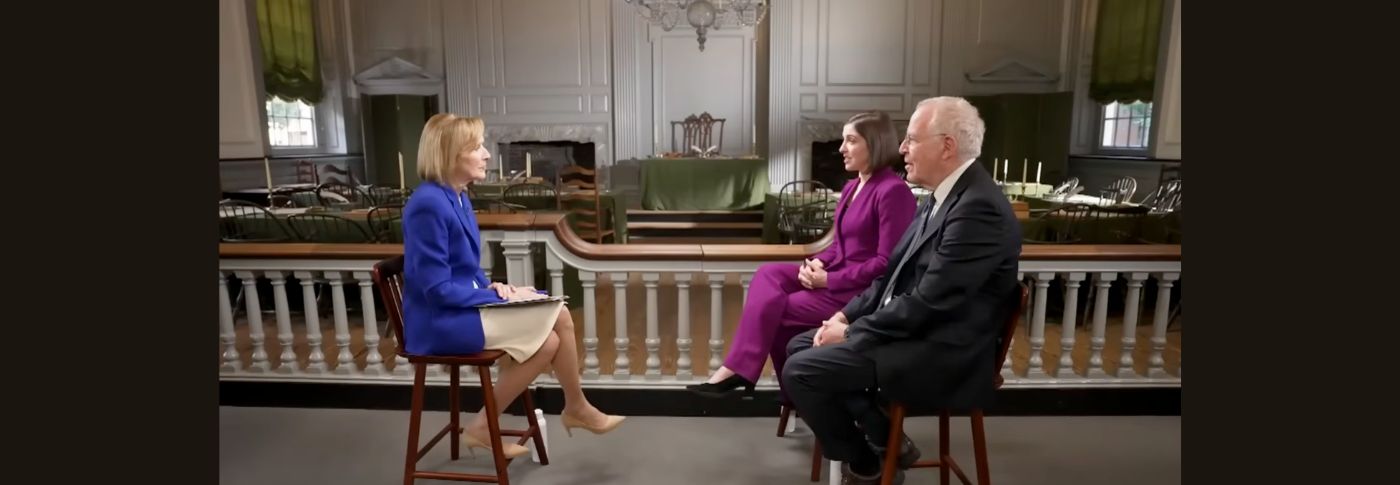
Judy Woodruff interviews historians Lindsay Chervinsky and Ron Chernow in the Assembly Room at Independence Hall.

Judy Woodruff speaks with historian Lindsay Chervinsky and biographer Ron Chernow in the Assembly Room at Independence Hall in Philadelphia, where the Second Continental Congress voted to declare independence in 1776. Photo: PBS NewsHour

July 23, 2026

America at a Crossroads: A Look at America's Founding from the Room Where Independence Was Declared

Judy Woodruff sits down with historians Lindsay Chervinsky and Ron Chernow inside Independence Hall to mark 250 years of American independence. Students explore the Declaration, its omissions, and what a more perfect union means today.

Share

Share On Facebook
Share On Twitter
Share On Pinterest
Share On LinkedIn
Email

In July of 1776, the Second Continental Congress officially voted to sever political ties with Great Britain and declare independence. In this week celebrating 250 years since the founding of the nation, and just ahead of Independence Day, Judy Woodruff brings us a conversation from a site synonymous with the Founding Fathers. It’s part of her series, Crossroads: America at 250.

View the transcript of the story.

NOTE: If you are short on time, watch the video and complete this See, Think, Wonder activity: What did you notice? What did the story make you think? What do you want to learn more about? You can also make a Google doc copy of these general discussion questions.

Remote video URL

Warm-Up Questions

  1. Who wrote the Declaration of Independence and in hindsight, why was that a surprising choice?
  2. What, given that the war had already been going on for a year, was the primary purpose of the Declaration of Independence, according to this piece?
  3. When did Jefferson finalize the document and what controversial grievance was ultimately removed?
  4. Where did the founding fathers find the formula that they adapted into the Declaration of Independence?
  5. Why does Ron Chernow believe John Adams and Benjamin Franklin may have regretted their decision to delegate the drafting of the Declaration of Independence?

Essential Questions

  1. How might the inclusion of the grievance that King George III had "saddled the colonies with slavery" changed the course of American history? Do you think that challenging the institution of slavery would have threatened the popular legitimacy of the independence movement?
  2. Do you think the founding fathers would approve of contemporary (current) efforts to create a "more perfect" union? Why do Chernow and Lindsay Chervinsky worry our "best and brightest" minds might be increasingly disinclined to seek leadership roles?
  3. Media literacy: Why do you think Woodruff chose to interview two renowned presidential historians for this segment? What other perspective(s) might have been useful to the discussion?

What Students Can Do

A. Read the full transcription of the Declaration of Independence in the National Archives. Then, write a 250-400 word essay that includes analysis of the following:

  1. One grievance against King George III that you feel the current U.S. government is also guilty of
  2. One grievance against King George III that you feel the current U.S. government has learned from/avoided
  3. Whether or not you think America is working towards becoming a "more perfect union" through constant self-improvement, as the founding fathers envisioned

B. Watch the following clip from the PBS News podcast series, "In Pursuit of Happiness," where Woodruff and Chervinsky analyze what made President George Washington such an effective leader.

Remote video URL

America at 250: From Revolution to Republic

This collection traces the nation’s journey from colonial life and growing resistance to British rule, through the Revolutionary War, the Declaration of Independence, and the creation of a new constitutional government. Organized thematically, the resources support instruction in U.S. history, civics, and ELA while encouraging inquiry, discussion, and critical thinking.

Republished with permission from PBS News Hour Classroom.

PBS News Hour Classroom
PBS News Hour Classroom helps teachers and students identify the who, what, where and why-it-matters of the major national and international news stories. The site combines the best of News Hour's reliable, trustworthy news program with lesson plans developed specifically for... See More
Advertisement

Post a comment

Log in or sign up to post a comment.