. Skip to main content
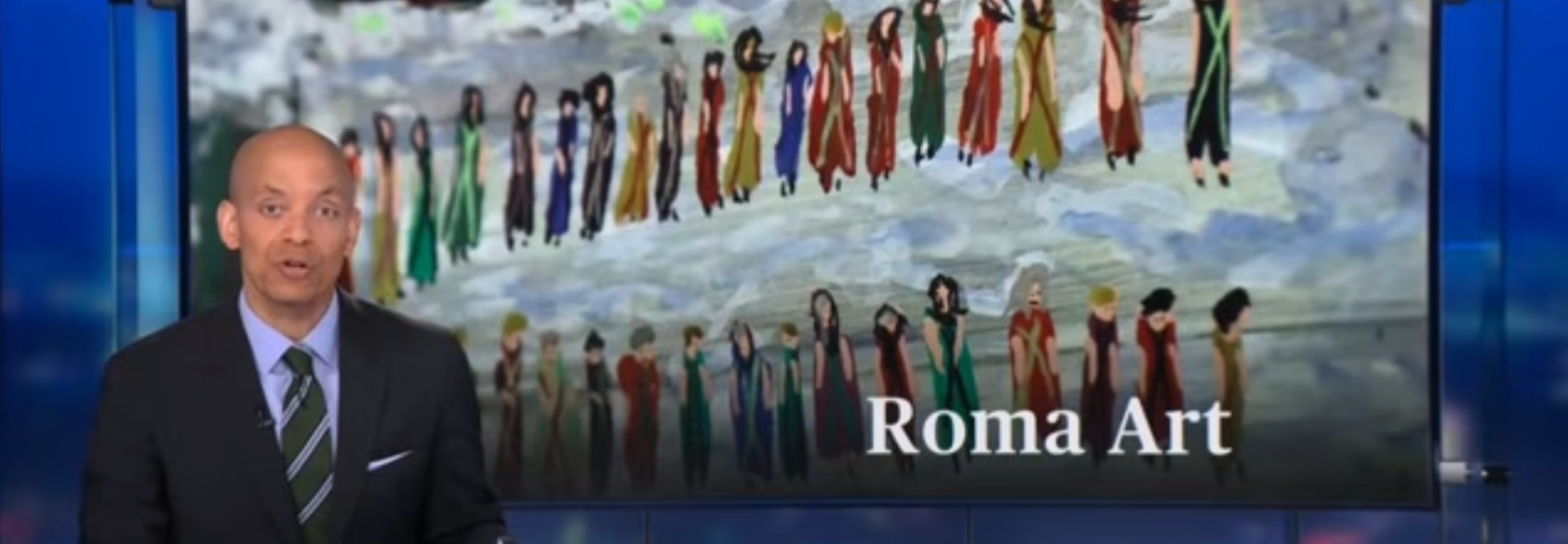
Geoff Bennett speaks with an image of Roma art behind him.

Credit: PBS News Hour screenshot

Art Exhibition Shines Light on Romani Persecution During Holocaust

April 30, 2026

Art Exhibition Shines Light on Romani Persecution During Holocaust

Ask students: How can art serve as a form of storytelling, advocacy and warning against resurgent racism and right-wing nationalism?
Share

Share On Facebook
Share On Twitter
Share On Pinterest
Share On LinkedIn
Email

It's a lesser-known chapter of the Holocaust, the murder of some 500,000 Roma and Sinti people, members of a long-marginalized and often persecuted minority in Europe. One way into that history is through the work of an artist who survived it herself: Ceija Stojka. Stojka died in 2013 at age 79, a writer, artist and activist who, says Rutgers professor Ethel Brooks, herself of Romani heritage and chair of the European Roma Rights Center, became a hero to many in her community and beyond.

View the transcript of the story.

NOTE: If you are short on time, watch the video and complete this See, Think, Wonder activity: What did you notice? What did the story make you think about? What would you want to learn more about?

Remote video URL

Warm-Up Questions

  1. Who was Ceija Stojka?
  2. Where is the Ceija Stojka: Making Visible exhibition being held?
  3. How many paintings and drawings are on display at the Ceija Stojka: Making Visible exhibition, and when were they made?
  4. What was the driving purpose of Ceija Stojka's work?
  5. Why is "making home wherever you are in the world" something that is central to Roma people's identity, according to Rutgers professor Ethel Brooks?

Essential Questions

  • How can art serve as a form of storytelling, advocacy and warning against resurgent racism and right-wing nationalism?
  • Jeffrey Brown describes Ceija Stojka's art as "not documentary in style, but acts of memory and imagination based on her own experiences and stories she was told." Do you think art is more impactful if it's documentary in style or based more on emotions? Explain.

Media literacy: In addition to displaying Stojka's paintings, the exhibition features documentary films by Karin Berger capturing Stojka's personality and drive to bring Romani history and culture, including music, as well as Stojka's writings, mentioning her 1988 memoir, "We Live in Secrecy".
  • Why do you think Stojka explores various forms of art (music, writing, and painting/drawing) to tell the story of the Roma people?
  • Do you think different media are more or less effective at conveying emotional meaning? Explain.

What Students Can Do

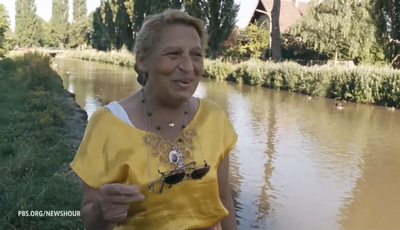
Credit: PBS News Hour screenshot archival footage of Ceija Stojka

In the PBS News Hour segment, reporter Jeffrey Brown and exhibition curator Lynne Cooke highlight several of Stojka's paintings, such as "Untitled (Ravensbrück Women's Camp)," "They Devoured Us," and "The Destitution, the Suffering, I Feel It Still." Cooke provides a brief analysis of the "Untitled (Ravensbrück Women's Camp)," stating that "it's the way she's painted the ground and the kind of liquidity and the kind of the cold palette that speak very effectively to our emotions."

Now it's your turn to analyze Stojka's work. Visit The Drawing Center's website on the Ceija Stojka: Making Visible exhibition and go through the photos of her artwork. As an additional resource, check out the Wende Museum's catalog for its exhibition titled Ceija Stojka and Scenes of Roma Life for more detailed explanations of some of her work. Using these resources, select another of Stojka's paintings to analyze.
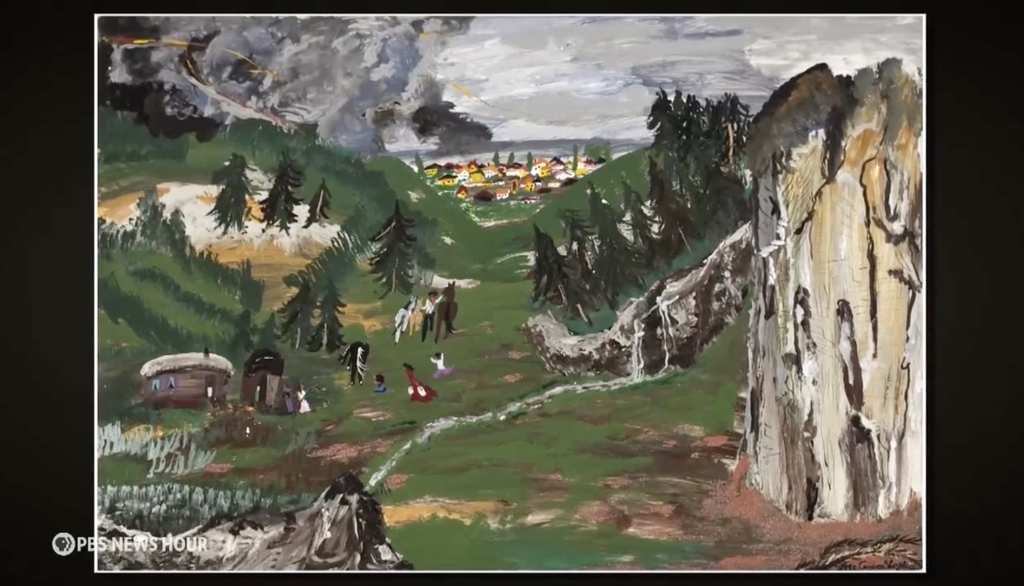
Credit: PBS News Hour screenshot of Ceija Stojka's painting "Untitled" at an art exhibit at The Drawing Center in New York City
  • Consider how the visual elements (color, composition, texture, lines, etc) communicate the piece's meaning.
  • Utilize the Student Art Guide questions to guide your analysis. Below are some selected questions:
    • Does the artwork communicate an action, narrative or story?
    • What kind of abstract elements are shown? Are they the result of spontaneous, accidental creation or careful, deliberate arrangement?
    • Do key objects, images, people or props have symbolic value or provide a cue to meaning?
    • How does the artwork convey deeper, conceptual themes?
    • What is your emotional response to the artwork?
    • What is the overall mood? Which subject matter choices help to communicate this mood?
    • Does the title change the way you interpret the work?

Written by Claudia Caruso, PBS News Hour Classroom's intern, and News Hour's Vic Pasquantonio.

Republished with permission from PBS News Hour Classroom.

Holocaust Education Resources

Teach the Holocaust with confidence. Explore free lesson plans and resources to raise awareness and analyze its lasting impact.

PBS News Hour Classroom
PBS News Hour Classroom helps teachers and students identify the who, what, where and why-it-matters of the major national and international news stories. The site combines the best of News Hour's reliable, trustworthy news program with lesson plans developed specifically for... See More
Advertisement

Post a comment

Log in or sign up to post a comment.