. Skip to main content
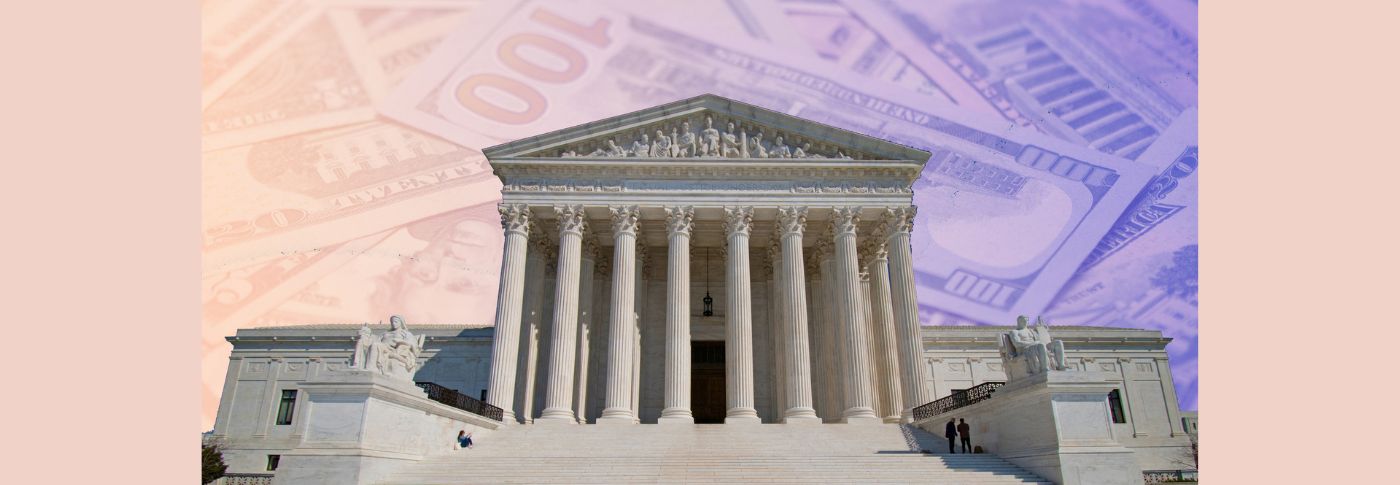
A composite image of the U.S. Supreme Court building overlaid with a soft-focus background of U.S. hundred and twenty dollar bills, representing the Court's landmark 2026 decision lifting limits on political party campaign spending.

The U.S. Supreme Court's conservative majority transformed campaign finance rules on July 1, 2026, lifting limits on how much political parties can spend in coordination with candidates on advertising and other campaign expenses. UCLA law and political science professor Rick Hasen told PBS NewsHour the ruling could have a significant short-term advantage for Republicans. Illustration: PBS NewsHour

Supreme Court Transforms Campaign Finance Rules, Lifting Limits on Party Spending

July 6, 2026

Supreme Court Transforms Campaign Finance Rules, Lifting Limits on Party Spending

The Supreme Court just blew open the doors on how much political parties can spend to get their candidates elected. Coming days before the 2026 midterm general election season heats up, here is what the ruling means for democracy, money in politics, and the upcoming midterms.

Share

Share On Facebook
Share On Twitter
Share On Pinterest
Share On LinkedIn
Email

The Supreme Court’s conservative majority transformed campaign finance laws, lifting limits on how much political parties can spend on advertising and other expenses in coordination with candidates. Amna Nawaz discussed the decision with Rick Hasen, a professor of law and political science at UCLA.

View the transcript of the story.

NOTE: If you are short on time, watch the video and complete this See, Think, Wonder activity: What did you notice? What did the story make you think about? What would you want to learn more about?

Remote video URL

Warm-Up Questions

  1. Who originally brought the lawsuit at the center of this case during their Senate campaign?
  2. What was the margin of the Supreme Court’s decision?
  3. What are super PACS?
  4. How are political parties expected to be affected by the decision?
  5. Which party might benefit the most in the short-term, according to this segment?

Essential Questions

  1. This decision came down during a key moment in the 2026 midterm election cycle. What effects might access to more money have for political parties as they enter the general election phase?
  2. What’s the significance of the Court, for now, upholding individual contribution limits?
  3. Media literacy: "Soft money," according to the Congressional Research Service, includes "funds generally perceived to influence elections but not regulated by campaign finance law”.
    1. As mentioned in the video, the 2002 McCain-Feingold Act helped to regulate "soft money," and while campaign spending didn’t stop, it moved to super PACs and other outside sources. What’s the risk of money being unregulated but known to be used in political campaigns? How has the reversal of the McCain-Feingold Act contributed to an increase in "soft money" in politics?

What Students Can Do

Read over the summary of Citizens United v. FEC (2010). Look at the facts of the case and the questions that the Court was attempting to answer, then read over the conclusion. After students are done reading this page, they should discuss the decision and how the Supreme Court’s recent ruling has followed the trend of limiting campaign finance regulations. Some guiding questions can be:

  • Consider the history of campaign finance rules stemming from the aftermath of Watergate. What was the goal with limiting contributions to candidates and parties in the first place?
  • Looking to the future, what is important to regulate in legislation regarding campaign finance?
  • What’s the risk in continuing to restrict then relax campaign finance laws every few decades?

The Supreme Court: Balancing the Branches Lesson Plans

Explore free, classroom-ready lessons on the Supreme Court, the Constitution, and the balance of power among the three branches. From landmark cases to today's biggest civic debates, Share My Lesson helps students build the background knowledge and critical-thinking skills to understand how government really works.

Republished with permission from PBS News Hour Classroom.

PBS News Hour Classroom
PBS News Hour Classroom helps teachers and students identify the who, what, where and why-it-matters of the major national and international news stories. The site combines the best of News Hour's reliable, trustworthy news program with lesson plans developed specifically for... See More
Advertisement

Post a comment

Log in or sign up to post a comment.