By Alvin Buyinza
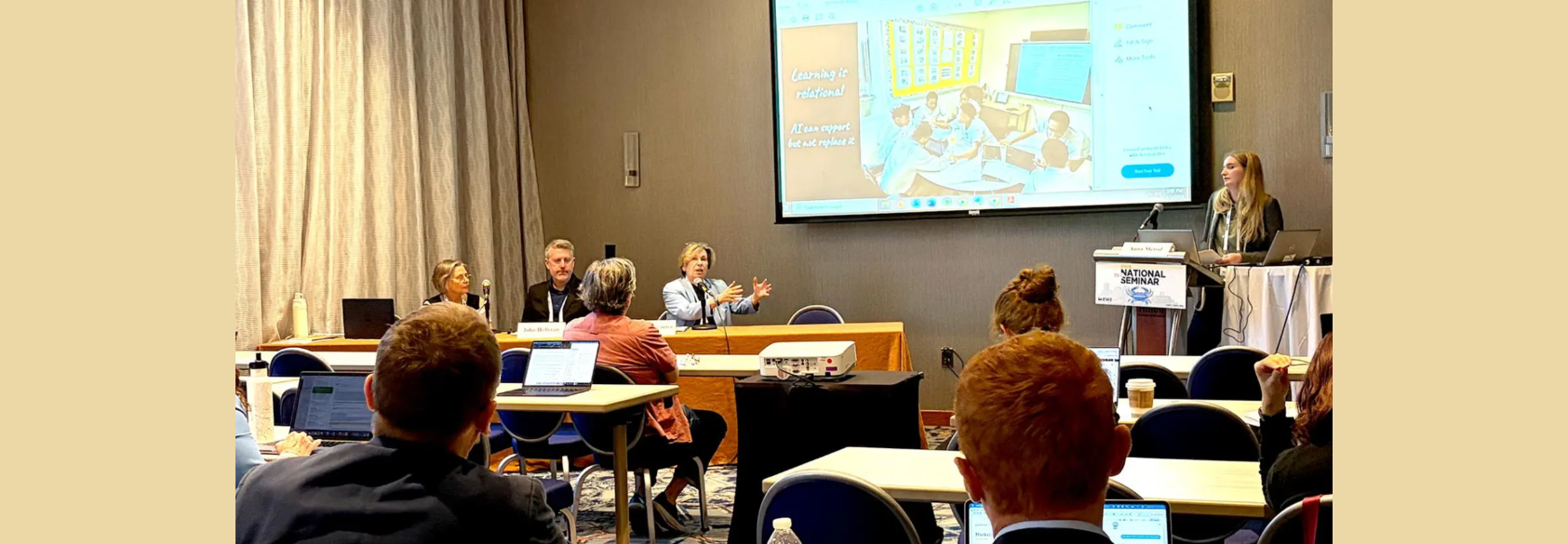
As the use of artificial intelligence gradually makes its way into the nation’s classrooms, teachers need to be trained on how this new technology works, so they, not tech giants, can be in the driver’s seat on how and when to use AI, AFT educators said during a panel discussion at the Education Writers Association National Seminar in Baltimore June 3.
Last July, the AFT partnered with the United Federation of Teachers, Microsoft, OpenAI and Anthropic to launch the National Academy for AI Instruction in New York City. The academy offers hands-on workshops to train teachers in AI so they can ensure its use is safe, fair, effective and ethical. Over five years, the program aims to train 400,000 teachers, 10 percent of the educator workforce.
The goal of the academy, AFT President Randi Weingarten said during a panel at the EWA National Seminar, is not to be a “cheerleader” for or “detractor” of AI. Instead, she wants teachers to be well-trained on how to use this technology.
“We are immersed in a new industrial revolution in this country,” she said. And yet, “the people who are supposed to be educating children” have been given either “no guidance” or “very little education about it.”
Across the nation, nearly 70 percent of teachers say they’ve received no guidance on how to apply AI to one-on-one instruction or tutoring, according to a survey released in May by Gallup and the Walton Family Foundation. And 47 percent of teachers say the same about using to make assignments and create other materials. The teachers who do receive guidance on how to use AI say the instruction is informal.
Weingarten’s remarks were made just a week after she unveiled a 10-point plan to address the growing national concern around tech and AI in the classroom during a major speech at the National Press Club in Washington, D.C. Weingarten explained that not only should there be reasonable guardrails to mitigate the potential harms of AI—such as students relying on the technology instead of acquiring and applying core knowledge and skills—but also educators need to remain instructional leaders, deciding when and how AI is used and ensuring students are developing the ability to think critically.
“If we don’t do something—even if it’s controversial—to get ahead of this, to help teachers have some efficacy with the tool and teachers teaching teachers about it, then shame on us,” Weingarten said during the panel.
Inside the AFT’s AI academy
John Holleran, an AFT member and AI academy instructor, said the AI partners aren’t involved in developing the content of the courses for the academy. It’s a completely teacher-led environment, where educators get to learn from one another about how AI works and how it can be used safely and effectively.
Sometimes, representatives from the AI partners will stop by the academy to gather feedback from teachers and answer their questions about AI, Holleran said.

Holleran and Weingarten both stressed the need to have a stronger federal investment in AI training for teachers on a national level. But currently there are no federal laws or regulations on the use of AI in classrooms. Weingarten criticized the federal government for not taking enough steps to address the lack of proper AI guidance.
As part of her 10-point plan, Weingarten is calling for the federal government to step up and establish an independent research consortium to study the effects of AI, screens and technology on students. The research shouldn’t be paid for by the industries whose products are being reviewed.
“AI is not a play toy,” Weingarten said. “It’s not just the newest plaything. It fundamentally changes the course of human history.” That’s why one of the most critical resources the AI academy provides is the AFT’s “Commonsense Guardrails for Using Advanced Technology in Schools.” Developed by educators, the guardrails offer practical guidance at a time when many teachers have received little direction on the use of AI in schools.
AI is a tool—‘like fire’
Linda Noble, an educator at Brooklyn College Academy in New York City, uses AI to teach her students. She said she’s excited to learn more about what this emerging technology can and cannot do for students.
She pointed to an image on a slideshow depicting a group of her students—whom she calls her “heroes”—sitting at a table talking with one another. The students were pretending to be diplomats engaged in negotiations during World War II. It was part of an educational exercise Noble developed with the help of an AI chatbot.
“It’s all about collaboration and cooperation,” Noble said.
Active learning projects like these speak to Weingarten’s “devices-down, eyes-up, hands-on” strategy, a teaching framework that emphasizes active learning and collaborative problem-solving amid the technological shifts that are changing the K-12 landscape. Active learning helps students think critically, work together and solve real-world problems. It’s “the antidote” to cognitive offloading, Weingarten said in her Press Club speech. Rather than AI giving students the answers, they must work together to come up with their own.
Noble echoed Weingarten’s perspective and added that she understands the limits of AI, noting that teachers—not AI—can read the room, understand how a student feels and truly know who their students are.
“These tools are very effective,” she said. “They are very efficient. It’s like fire. We can cook, and we can burn. And I think we need to find a middle space, so that we’re in command, as humans, and our relationships are always centered.”
Republished with permission from AFT.