


When You Hold the Power: What Educators Need to Know Before They Report to Child Protective Services
Explore how educators can support families in crisis, recognize bias and use a three-tier framework before reporting to child protective services.

Share
August 3, 2026
Explore how educators can support families in crisis, recognize bias and use a three-tier framework before reporting to child protective services.
Share
Miesha Parker presented her story, her analysis and her tools for the 2026 Share My Lesson Virtual Conference in a webinar titled, “From Mandatory Reporting to Mandated Support: Understanding Educator Power to Transform Family Crisis Response.” This blog complements her presentation, which you can access free and on demand.
I remember when my son was first accepted into his school. The principal came to our home, knocked on our door, introduced herself, told us about the school's mission, and met my son. That visit meant something to me. It said: “We see your family. We want to be in relationship with you. You can trust us.”
That was the beginning of what I believed was community trust.
So, when my family entered a moment of crisis, when I was navigating domestic violence, when I made the decision to temporarily move my son to my mother's home while I got safe, while I made a safety plan, while I tried to hold myself together enough to figure out my next steps, I thought telling his teacher was the right thing to do. I thought giving her that context would help her understand why things might look different for a while. Help her support my son if his behavior shifted. Help her see that his mother wasn't gone. She was healing.
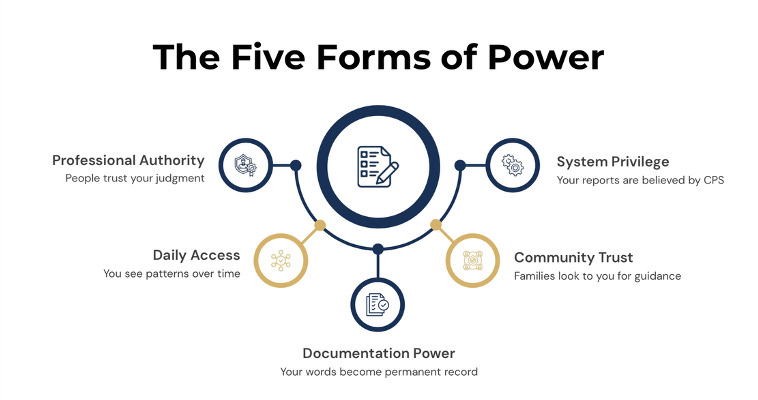
What I didn't fully understand then is what I now spend my career helping educators understand: That teacher held five forms of power over my family. And every single one of them was used against us.
Hear me talk about this experience with AFT Share My Lesson:
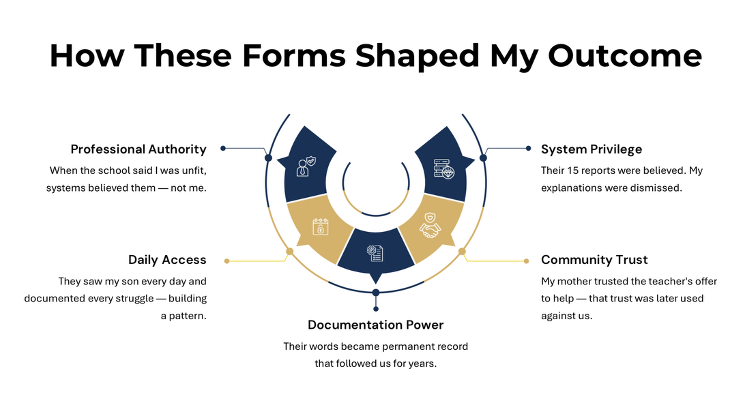
Community trust is what I extended when I opened my door to that school, when I shared what my family was going through, when I believed we were in a relationship built on mutual care. That trust is real. Families, especially Black and brown families, families from underserved communities, and families in crisis extend it carefully because the risk of extending it to the wrong person is enormous. And when that trust is violated, it doesn't just harm one family. It confirms what so many families already know and fear: that reaching out for help, especially to anyone with mandated reporting power, can get your family investigated, surveilled and separated.[1] That fear is not irrational. It is learned. It is passed down. And it is one of the primary reasons families don't ask for help even when they desperately need it.
What my family needed was not a report. I needed domestic violence advocacy and counseling. My mother needed respite services. She was the sole caregiver for my son during an incredibly difficult time, and she was overwhelmed; and that feeling was real and human and completely understandable. My son needed age-appropriate support to help him process why things at home had changed. Those resources exist. They were accessible. No 51A required.*
Instead, the teacher made herself the resource to my son—and a weapon against his family. She approached my mother, not me, and offered to keep my son for a few days at a time to give her a break. My mother, exhausted and desperate for relief, said yes. I didn't know this was happening. I would never have approved of it. But by the time I found out, it was already a pattern. And in the eyes of the court, it was already a transition.
I was invited to a meeting at the school. I walked in thinking it was about support, about my son's behavior, about what the school was observing, about how we could
work together. I walked out knowing they had already filed multiple reports while the teacher had been conducting overnight stays with my son. While she had been quietly positioning herself as his caregiver. She wasn't offering help. She was building a case. And she was preparing to become his foster parent.
Documentation power is how she built it.
Every late drop-off noted. My mother's visible stress, documented. My son's behavior, the behavior of a child who missed his mother and didn't understand why his world had shifted, recorded as evidence of neglect rather than grief. My absence during a period when I was healing from violence, written as abandonment rather than safety planning.
The words educators choose are not neutral. They are not just descriptions. They are determinations. "Mother abandoned child" and "mother implementing a safety plan while healing from domestic violence" describe the exact same moment. Only one of them is true. Only one of them was in my file.
Crisis does not equal identity, but inside these systems, it does. Once a case is open, once an investigation is conducted, that record travels through systems, throughout the years. Sometimes through generations. The way an educator documents a family's hardest moment can follow that family long after the crisis has passed.
Professional authority, daily access, and system privilege completed the picture.
When I tried to tell my truth, the teacher had already told hers. And hers came with a title, a mandatory reporter status, and 15 51A reports. The court believed her. The system believed her. And I had no recourse because here is something most families don't know until it's too late: Educators who report “in good faith” are protected: immune from civil and criminal liability, protected from employer retaliation, and their identity kept confidential. Even if the report is unsubstantiated. Even if the investigation finds nothing. Even if a family is torn apart in the process.
The family has no equivalent protection. There is nothing I could do. No way to hold her accountable for violating the trust I extended, for the documentation she weaponized, for the transition plan she built without my knowledge or consent. In the eyes of the law, the teacher acted in good faith. In the reality of my life, I lost my son.
I want educators to sit with that asymmetry. Not out of guilt because guilt doesn't change systems. But out of conscience because educators hold power that families do not have, and that power deserves more intentionality than most mandatory reporter trainings ever ask of you.
Hear me talk about this experience with AFT Share My Lesson:
Here is something mandatory reporter trainings almost never teach you: why this system exists in the first place.
The Child Abuse Prevention and Treatment Act, CAPTA, is the federal legislation that codified mandatory reporting as we know it today. It requires educators and other professionals to report suspected abuse and neglect. And built into that requirement is a threat: Fail to report and you risk losing your license. That threat is real and it matters, because it means educators are operating inside a system that is structurally designed to push toward reporting, even when what they are actually seeing is a family in crisis, not a family causing harm.
I want you to sit with that for a moment. You are not just making an individual choice when you file a report. You are operating inside a federal mandate that was built to cast a wide net, that expanded surveillance of families, and that offers you protection for reporting while offering families almost nothing in return.[2]
CAPTA is not the only piece of federal legislation from that era worth knowing about. In 1978, the Indian Child Welfare Act was created specifically because Native children were being removed from their families and communities at catastrophic rates, separated from their culture, their language, their identity, by a child welfare system that didn't understand or respect what it was looking at. The ICWA was a direct response to the harm that family separation causes when power goes unexamined and systems go unchecked. That history is not separate from what is happening in schools today.[3] The same story continues.
What CAPTA mandates is suspicion, not evidence. The bar for reporting is low by design. And what the research consistently shows is that the majority of those reports, particularly reports filed by educators, are unsubstantiated. Cases closed. Families found not to have abused or neglected their children. But here is what unsubstantiated does not mean: It does not mean the family wasn't harmed. The investigation still happened. The home visit still happened. The child was still questioned at school without their parents’ present. The record still exists. The trauma is real whether or not the case goes anywhere.
This is especially true for survivors of domestic violence. One of the most devastating consequences of mandatory reporting as it currently operates is that the fear of family separation, the fear of what happens when you tell someone in a position of authority that your home is not safe, keeps survivors from seeking help. Not because they don't want help, but because they have watched what happens when families like theirs reach out. They know the risk. And that risk is not imaginary. It happened to me.
Black and brown families are reported at significantly higher rates than white families presenting the same concerns. That is not an opinion. That is documented in the research.[4] And it means that the system educators are participating in when they file a report is not a neutral one. It carries the weight of racial bias, of cultural misunderstanding, of a long history of treating poverty as neglect and crisis as character failure.
None of this means mandatory reporting should not exist. It means it should be used with the full weight of understanding what it actually does. That is what the framework I teach is built on, not a rejection of your responsibility, but a deeper understanding of it.
The framework I teach now came directly from what happened to my family.
It is called the Three-Tier Decision Framework, and its core ask is simple: Before you act, stop and think through what you are seeing and what your next action will actually do to this family. And I want to be clear; that pause, that intentionality, applies to every tier. Even when danger is real and immediate and a report is necessary, how you document it, how you speak to the child, how you handle that family in that moment still carries weight. The tier determines the action. Your humanity determines how you take it.
Tier 1 is immediate danger, physical or sexual abuse, severe neglect causing immediate harm, a child expressing fear about going home. Report. Do not delay. But even here, think about your words. Think about your documentation. Think about how the child in front of you needs to be held in that moment.
Tier 2 is family crisis without immediate danger, and this is where the vast majority of educator reports originate.[5] Housing instability. Food insecurity. A parent navigating domestic violence. A grandmother stretched past her limit. A child acting out because his world just changed. This is not danger. This is crisis. And crisis requires support, not surveillance. Before you reach for the phone, talk to the family. Ask directly: “We've noticed your family seems to be going through something. How can we help? What do you need?” Then consult your team. Connect to resources. Document what support you provided. The research is clear: Most educator reports are unsubstantiated, which means that in most of those cases what those families needed wasn't an investigation. It was someone to ask the right question.
Tier 3 is ongoing support, staying engaged, following up, continuing to connect resources, documenting from a strength-based perspective that gives context to what a family is actually navigating rather than building a portrait of who they are at their worst moment.
There is also a structural piece that cannot be overlooked. Schools serving diverse communities, METCO schools,* urban schools, schools where the students come from different cultural and economic backgrounds than the educators serving them, need experts involved in these decisions in a meaningful way. And I want to be specific about what “meaningful” means, because too often it does not mean what it should.
Inviting impacted parents and community members to sit on advisory boards, attend meetings, and share their perspectives without compensating them, without giving them actual authority, and without centering their expertise in the decisions that get made, is not inclusion. It is tokenism. And families who have navigated these systems know the difference. They can feel when their presence is a checkbox and when it is genuine.
What I am talking about is something different. Hire lived experts* into paid roles with real decision-making authority. Give them titles, compensation and standing inside the institution. Not a volunteer position. Not a seat at a table where their input is optional. Give them a job, with the same professional respect afforded to every other staff member in that building. Hire someone who comes from the communities you serve, who understands what families are navigating, and who has the institutional standing to intervene before a report is filed rather than being consulted after the damage is done. That person is also the one who knows the local resources, the organizations actually embedded in the community, the cultural context that no training can fully replicate. That knowledge is expertise. It should be compensated as such.
Hire from the communities you serve. Partner with cultural organizations. And when you bring lived experts into your building, pay them, listen to them and position them to lead.
In the video below, we outline how schools can work with lived experts:
Two questions came in after the Share My Lesson Virtual Conference webinar that I've been thinking about ever since.
A kinship caregiver who attended shared something that stopped me. She said she had been the one begging the school to support her children's mother, and the school simply wasn't responding. She wanted to know how schools can make this framework realistic when the will to act isn't there.
I want to be honest about what she was describing. She wasn't asking about resources. She already knew what was needed. She was standing right in front of the school administrators telling them what was needed. And they still didn't move. That is not a resource problem. That is an orientation problem. And it is a failure.
To educators reading this: When a caregiver comes to you and tells you directly what a family needs, that is the clearest Tier 2 signal you will ever receive. There is no ambiguity, no judgment call, no gray area. The question has already been answered for you. Choosing not to respond is still a choice. And it has consequences for that family.
For caregivers in that position, here is what I would say: Put your request in writing so there is a documented ask on record. Go directly to the school social worker who has their own professional obligations separate from the classroom teacher. Contact the district's family engagement coordinator. Bring in a parent advocate or community organization to help apply pressure. You should not have to do any of that. But documenting that you tried matters, and it creates accountability.
And this is exactly why community connection is not optional for schools. If that school had a genuine relationship with its community, had people in paid roles whose job was to know what families needed and connect them to it, there would have been someone already in that building whose role was to be responsive to exactly what that caregiver was asking for. She would not have been begging. There would have been a pathway. Schools that are truly connected to their communities do not wait for a family to reach out in desperation. They already have people in place who know what support looks like before crisis arrives. That infrastructure is what makes this framework realistic at scale. Individual educator goodwill has a ceiling. Community connection raises it.
Practical resources that every educator should have within reach:
These are starting points, not a complete list. Part of doing this work well is getting familiar with the local organizations actually embedded in the communities your students come from. The national hotlines will always be there. But the community health center three blocks from your student's home, the domestic violence organization that does outreach in their neighborhood, the food pantry connected to their place of worship. Those are the resources that meet families where they actually are. Know your community. Know its resources. That knowledge is part of your responsibility too.
You do not have to report a family to support a family.
Hear from a New York City educator who trained thousands of her peers when the state required all new training grounded in this mantra, “You do not need to report a family to support a family.”
An educator also asked what to do when a principal says, "Report it, let the authorities sort it out." That is a real directive that real educators are receiving, and I am not going to minimize it.
But I want to push back on the idea that the principal's directive is the end of the conversation. You still have professional obligations that belong to you, not your principal. Before any report is filed, you can initiate a pre-report consultation with your school social worker or counselor and document that you did. You can put in writing, even just an email to a colleague, that you raised the question of what support this family needs before filing. You can ask your principal directly, on record: Have we offered this family anything before making this report? That question, asked respectfully and documented, shifts what is on record about how your school responded.
You can also use the bias check framework as a professional practice. Ask yourself out loud, with your team: Would we respond the same way if this family lived in a different ZIP code, if this mother was white, if this child attended a different kind of school? That is not an accusation. That is a professional responsibility. And if the culture in your building consistently pushes toward surveillance over support, that is a conversation worth having with your union. The AFT exists precisely for that.
You may not be able to change your principal's directive in the moment. But you can document your process, build a record of intentionality, and refuse to let the directive be the only thing that defines your response to that family.
I said at the beginning of this piece that the principal coming to my home when my son was first accepted into that school felt like the beginning of community trust. And I believed that for a long time.
What I understand now is that it was also the beginning of access. The school coming inside my home before anything had happened. I opened my door, extending trust, believing that relationship was mutual. And when my family entered crisis, I extended that trust again by telling my son's teacher what we were going through. I thought I was giving her context. I was giving her a case file.
I share that not to make educators afraid of the relationships they build with families. I share it because those relationships carry weight that educators need to reckon with honestly. When a family trusts you with their truth, that trust is not just an opportunity to support them. It is a responsibility. And how you hold it, what you do with it, what you write down and what you leave out, what you offer and what you withhold, determine whether that family ever trusts a school again.
The families sitting across from you are at their hardest moments. And how you choose to respond to those moments will follow them long after you have moved on.
Use your power wisely. Use it to support, not surveil. Work with families, not against them. That is what this framework asks of you. And it is the least that families in crisis deserve.
*A report to Child Protective Services, or the Massachusetts Department of Children and Families, is known as a 51A, based on the statute in which mandatory reporting appears in the state code.
*The Metropolitan Council for Educational Opportunity enrolls thousands of Boston students of color in predominantly white school districts.
*Lived experience and lived expert" are terms to describe someone whose expertise comes not from academic credentials or professional training, but from what they have survived and navigated within systems that have directly impacted their lives. Nothing endured within those systems can be learned from a book. In the context of this piece, lived expertise refers to the knowledge held by impacted parents and community members who have been targeted by the child welfare system, an involuntary scholarship that cannot be replicated in a degree program or fellowship. My credentials are based on my life experiences as a Black woman and parent who was forced to navigate a system designed to separate Black and brown families. Lived experts come from all walks of life and all kinds of systems, child welfare, housing, criminal justice, healthcare, that have been constructed in ways that harm and diminish humanity. That knowledge is irreplaceable. And it deserves to be compensated as such."
[1] Fong, K. (2023). Investigating Families: Motherhood in the Shadow of Child Protective Services. Princeton University Press
[2] Raz, M. (2020). Abusive Policies: How the American Child Welfare System Lost Its Way. The University of North Carolina Press.
[3] Prax, C. (2024). “Past and Present: The Trauma of Family Separation.” American Educator.
[4] Labrenz, C.A., Littleton, T., Shipe, S. Bai, R. & Stargel, L. (2023). “State Policies on Child Maltreatment and Racial Disproportionality.” Children and Youth Services Review, 151(August 2023), 107048. doi:10.1016/j.childyouth.2023.107048
[5] Prax, C. (2025). “Nobody Wins: Educators’ Perspectives on Mandatory Reporting.” AFT & University of California, Irvine.
This free webinar balances vulnerability with practical skill-building, avoiding blame while providing concrete tools educators can use immediately. Participants receive downloadable resources including decision frameworks, bias recognition checklists, and dignity-preserving language guides.
The AFT’s mandated support resources help school communities move beyond traditional reporting practices toward caring, trauma-aware approaches that prioritize student wellness and family resilience. Explore guidance, tools, and expert insights that empower every adult in a school to take compassionate, confident action when concerns arise.


