


Side Quests to Avoid the Wrong Hill to Die On
Teaching veteran Amber Chandler shares three practical "side quests" that help educators focus on what matters most instead of fighting every classroom battle.
Share
June 29, 2026
Teaching veteran Amber Chandler shares three practical "side quests" that help educators focus on what matters most instead of fighting every classroom battle.
Share
Lately, as I’ve been reflecting on the state of education, always an end-of-year topic of conversation with my teacher friends, I’ve realized that we all have “hills I’ll die on.” From Oxford commas (a resounding yes) to assigning homework (a loud no from me), wherever two or more educators are gathered together, there are opinions! The conundrum, of course, is that sometimes the hills in front of you aren’t yours–they are someone else’s passion project or directive from on high. As the year is closing out, I’ve come up with another category to help teachers survive: side quests I’ve taken to avoid the hills I will not die on.
I’ve always hated final exams. I don’t think a single measure should ever count for much. I’m in a unique teaching position, in that I teach two honors classes and three classes where about half are students with special needs. The students in my honors classes usually have nowhere to go but down. For example, if a student has a 98 average after a year of revisions, studying and hard work, they have to get at least a 98 on their final exam, or their overall grade will go down. That seems unnecessarily punitive for a task that is typically completed in really hot classrooms when students are burned out. The same is true for my students who struggle. Many of them work ridiculously hard to improve their work, but when an exam comes, they become frustrated, overwhelmed, or simply give up because it is the only time that we are not coaching them. No matter how an exam is given, it does not replicate the real world where we support our learners.
No matter how an exam is given, it does not replicate the real world where we support our learners.
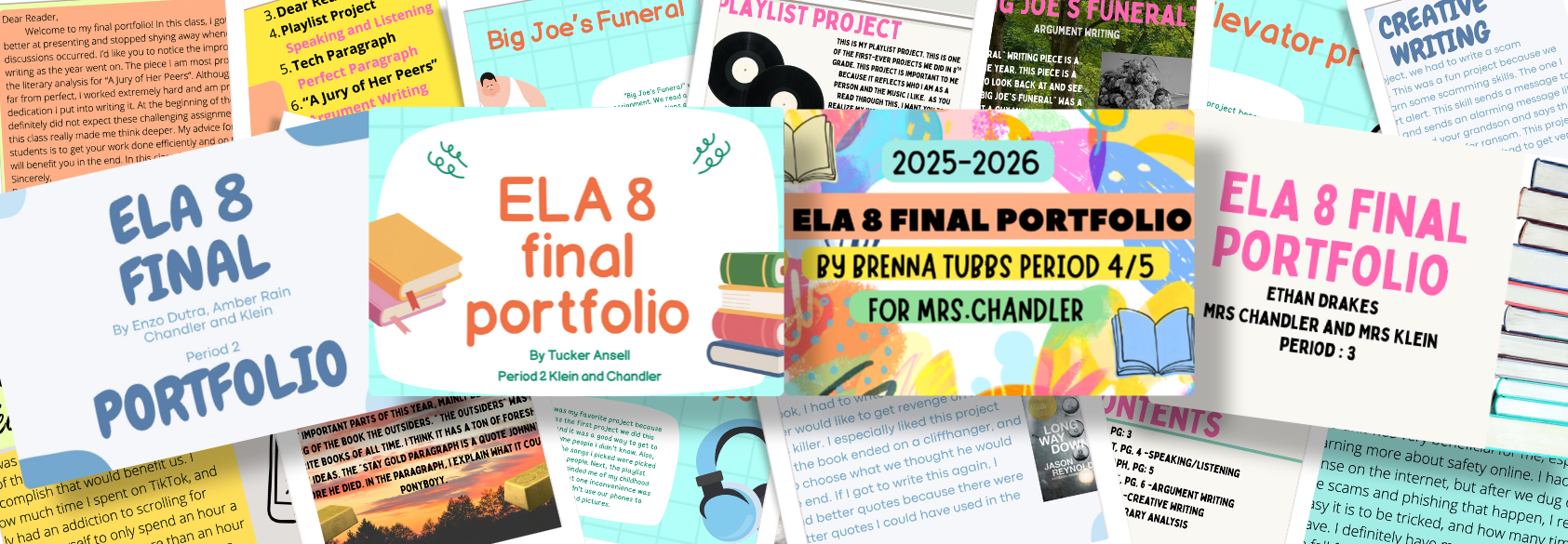
What side quest have we devised? My co-teacher and the other eighth-grade ELA teachers pretty much begged for an alternative to a final exam. Here is our proposal with the justification. Here is the side quest we take our students on instead of dying on the hill of standardizing learning, while we differentiate for the rest of the year. This is our digital portfolio assignment, our very detailed rubric, and even the “Are You REALLY Done?” checklist before submitting. Here are some examples (with their permission, of course): Brenna Tubbs, Tucker Ansell, Ethan Drakes and Enzo Dutra represent a cross section of my students, and their portfolios highlight their unique skills and personalities.
I’ve written extensively about cellphones, with a wide range of constantly evolving opinions. “Disrupting the Cell Phone Situation” webinar, “Is Education Ready for a Digital Detox? Are You?”, and “Cellphone-friendly-ish: Digital Citizenship for Realists” are only a few examples of my wide range of thoughts about phones. I write about cellphones in the early chapters of my new book, Reclaiming Connection, and this article, “How Tech-Dependency and Pandemic Isolation Have Created ‘Anxious Generation,’” explains my latest take. What does this have to do with artificial intelligence? Well, I blame myself for blindly leading my children into the cellphone trap. When I look back at how cellphones went from being a great way for my own kids to practice their ABCs with educational games to full-blown addiction, I am mortified. Mistakenly, like me, a lot of parents accepted cellphones at face value without waiting to have a true lived experience.
Just as I tell my students during our Digital Citizenship unit, people used to tout the benefits of cigarettes, too. Even doctors advertised how great cigarettes were. I’m not willing to make another mistake in judgment by “teaching” my students AI. It doesn’t mean that no one should teach them how to use AI—of course, they should. I’m positive that there are uses of AI that are extremely valuable. (Share My Lesson’s AI Educator Brain has amazing resources!) I’ve simply decided that I have other topics that are desperately needed for my eighth-graders right now.
The evolution of AI has happened so quickly that it feels quite a bit like when I handed my son my phone to play Ant Smashers (a game whose entire point was to smash ants by tapping the screen), thinking it was eye-hand coordination instead of realizing that this innocent game was rewiring his brain to crave the dopamine hits! This is how I feel justified in giving AI some time to play out a bit more before I make it a part of my curriculum. Instead of teaching AI, I have been doing a Digital Citizenship unit for the last several years. It allows me to help students see how they are using technology, exploring the pitfalls and perks for themselves. This blog from Ami Turner DelAugila provides “6 Strategies for Teaching Digital Citizenship and Balance in the Era of AI” that guide this type of approach. This “Media Literacy Classroom Resources” Collection is a good place to start if you are unsure of how to approach screens in your classroom. I’m guessing many people are going to disagree with me about this hill, and that is OK! There will always be the maverick, progressive, innovative teachers who lead the way, but this time it isn’t me. That hill is not one I’ll die on.
To say that teaching has changed—evolved or devolved, depending on the day—is a huge understatement. As I prepare to write the second edition of my first book, The Flexible ELA Classroom, it has been humbling to look back on the last decade. When that book came out, I did not use Google Classroom, had no idea there were magical, self-grading Google Forms that would allow me to never grade a multiple-choice quiz again, and, of course, I didn’t know that students would use/abuse AI to write papers. As I look at the chapters like “Choice Boards” and “Strategic Groupings,” I am confident that my classroom needs to transition back and implement some of the tried-and-true pedagogical decisions I once made. I’ve been willing to be that innovative teacher who utilized all the newest tools but, right now, I need some time with the Ghost of Classrooms Past to think about what works!
This past year, it became clear that my students—even the honors kiddos—need more structure, organization and scaffolding to be successful in high school.
I once had a dream of creating an ELA World (with a cooler name) with digital badges, replete with quests and hidden treasures. Think Legend of Zelda meets The Magic School Bus. I had clear ideas of what eighth-graders needed to know for high school and what would make them successful. This list was (and still is) a valuable starting point. My students love Blooket. The embedded games do keep them interested, and I like the ability to randomize the activity, not show names, and the element of chance. However, in consultation with the Ghost of Classrooms Past, I will leave the gaming to the professionals. Instead, I’m going to be returning to the old standards from a decade ago: choice, checklists and overt instruction (particularly around organization tools).
This blog, like the end of this year, has left me unsettled. In no way am I suggesting that AI instruction isn’t necessary, or that gamification doesn’t have its place, but rather, there’s a responsibility as an educator to see who is right in front of you and meet them there. This past year, it became clear that my students—even the honors kiddos—need more structure, organization and scaffolding to be successful in high school. I’m sure that educators are seeing different things, but I’m hoping those reading this might agree that we need to choose our “hills to die on” very carefully!
Looking for classroom-ready ways to strengthen these skills? Browse our collection of digital literacy lessons, activities, and professional learning resources designed for grades 6–12.
Join the team from the AI Educator Brain, which includes AFT’s Share My Lesson director Kelly Booz; New York City Public Schools teacher Sari Beth Rosenberg and EdBrAIn, our AI teammate (yes, it named and designed itself!). In this community, we will dissect the pros and cons of AI tools in education. Our mission: to determine how AI can support teaching and learning, and when it might be best to stick with tried-and-true methods.


