Explore how Americans have celebrated the Fourth of July in early U.S. history and discover classroom-ready primary sources and activities to inspire your classroom or community's jubilee of freedom all year long.
Fireworks light the sky in a grand moment. A community’s bell rings in celebration. Children revel in summer fun and indulge in delicious sweets. Someone reads aloud the Declaration of Independence. These are some of the common activities that are as familiar to us on Independence Day as they were to the founding generation. Then, there are also conversations and activities that reflect the ongoing pursuit of liberty that have emerged in 250 years of history.
From 1776 to 2026, people in the United States have found ways to use Independence Day to celebrate, reunite and challenge what it means to be “proud to be an American.” Let’s take a look at some of the emerging traditions or sudden events in 1776, 1812 and 1863.
John Adams’ Vision
On July 2, 1776, John Adams—a tireless advocate for independence and member of the committee that drafted the Declaration of Independence—wrote to his wife:
“The Second Day of July 1776, will be the most memorable Epocha, in the History of America. I am apt to believe that it will be celebrated, by succeeding Generations, as the great anniversary Festival. It ought to be commemorated, as the Day of Deliverance by solemn Acts of Devotion to God Almighty. It ought to be solemnized with Pomp and Parade, with Shews, Games, Sports, Guns, Bells, Bonfires and Illuminations from one End of this Continent to the other from this Time forward forever more.” (Read the letter here and also a Spanish translation here.)
Interestingly, Adams believed that July 2 would be the celebratory date. It is the day that the Continental Congress voted in favor of independence. However, July 4 got the honor and is the day that Congress voted to adopt the Declaration of Independence.
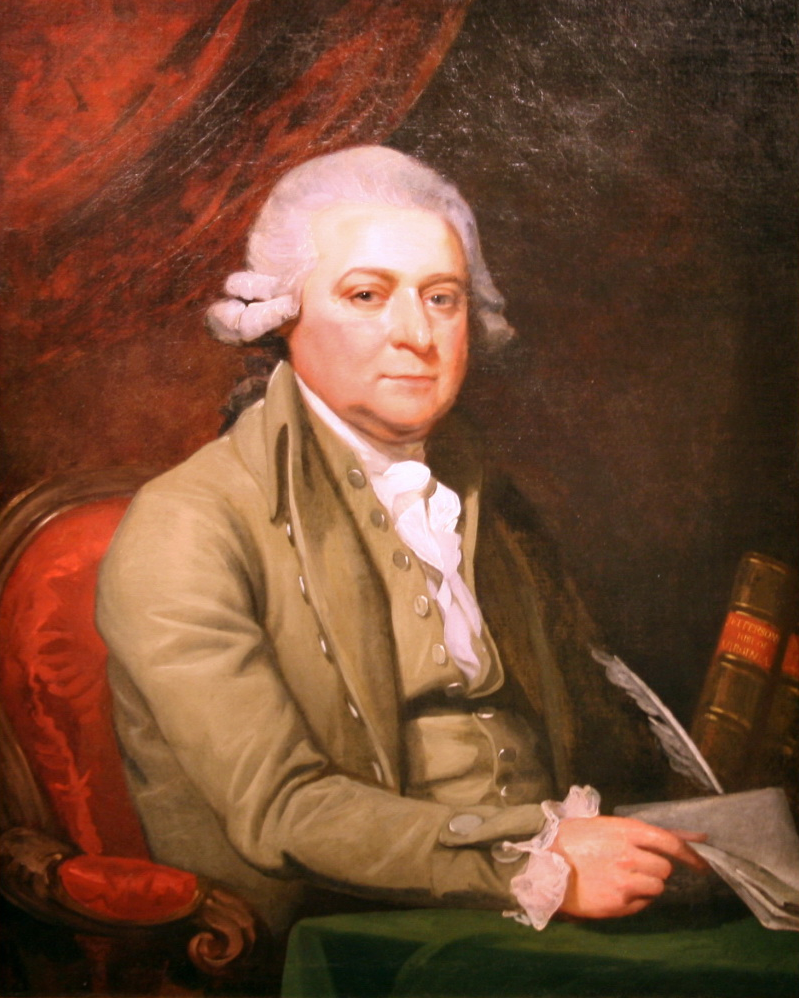
Portrait of John Adams, painted by Mather Brown in 1788 (public domain)
Though he guessed wrong on the date, Adams successfully predicted many of the activities Americans have enjoyed celebrating. Many places of worship offer reflections or commemorations on their days of gathering near the holiday. Shows, games and sports continue to be part of the American scene, from musical performances and professional entertainment to tossing a football or frisbee in the park. “Guns” as John Adams writes reflects both the 18th-century tradition of shooting blanks to make celebratory noise and the gathering of troops or local militia for s parade or muster. Bells ringing in church or civic bells to summon a community’s attention. And finally, “Illuminations” refers to the candles in the windows of homes and public buildings and fireworks!
Activity:
Explore a new lesson plan or select primary sources for learning about the Declaration of Independence.
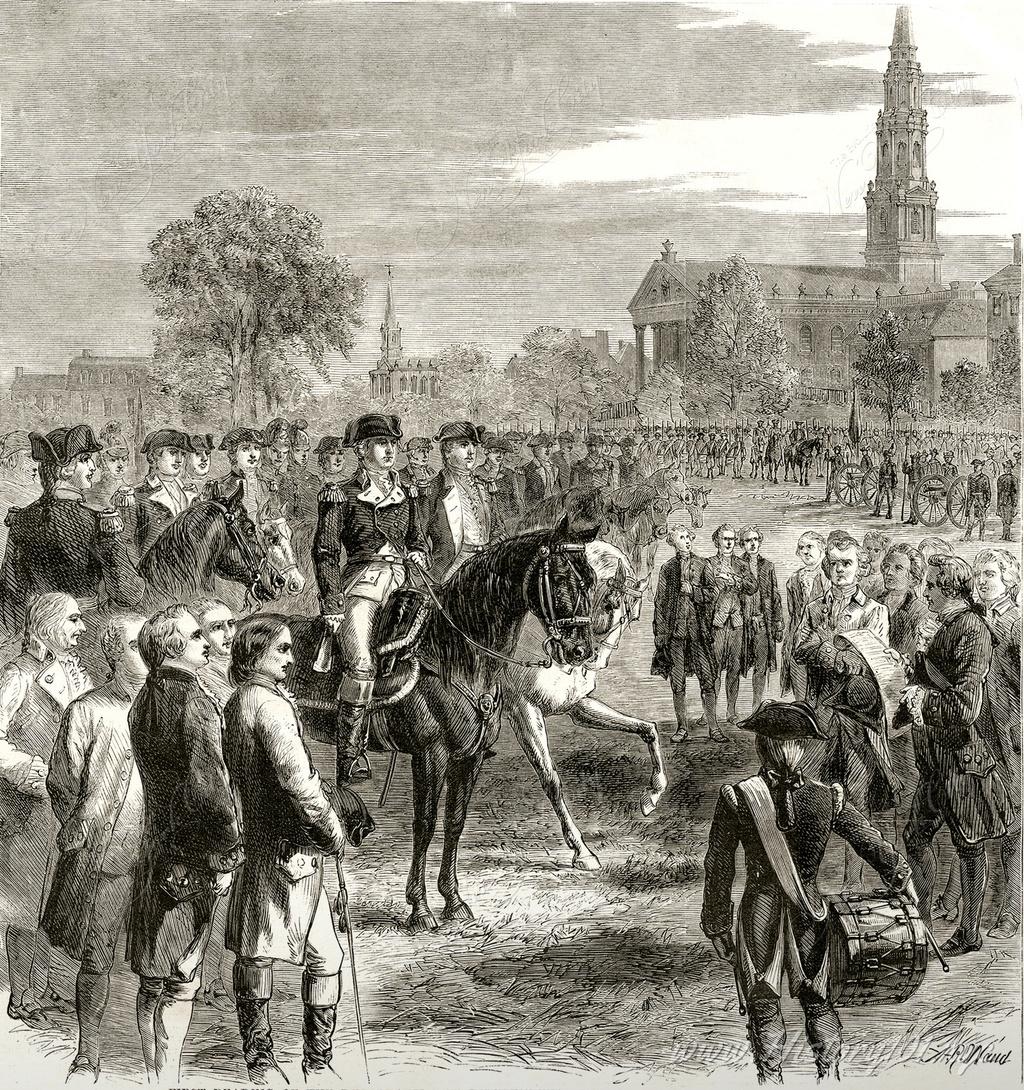
Fifty-six men declaring “that these united colonies are and of right ought to be free and independent states” was a start. But those united colonies were locked in a bloody war with one of the 18th -century’s global superpowers: Great Britain. Even as George Washington read the Declaration of Independence to soldiers in the Continental Army, a British fleet and army threatened New York City. Independence would have to be defended and, eventually in 1783, secured by the war’s end and the Treaty of Paris.
Sketch of George Washington reading the Declaration of Independence to troops near New York City (public domain)
The news of the Declaration of Independence traveled through the 13 states. Public readings of the document were given, and responses varied. Patriots in New York City had a dramatic response: A crowd toppled an equestrian state of King George III, leaving no doubt about their sentiments. Still, with a high-stakes war and little news to celebrate from the military campaigns, celebrations of independence were more defiant than joyous in 1776.
Activity:
Could you host a 250th birthday celebration?
If cake isn’t an option, consider a paper or recycled-material version, with students adding a symbolic “candle” (paper, LED or drawn) and sharing something or someone from history that inspires them.
Balloons and streamers!
American “Presents”—photos of American landmarks or famous places, wrapped, and then unwrapped to discover. Maybe one for each of the 50 states? Maybe National Parks? Maybe a historic quote? So many possibilities!
Happy 250th Birthday, USA! (Pixabay)
Celebrating in 1812
Fourth of July in 1812 offers a particularly interesting moment to explore, both politically and historically. Some of the older nation-founding men and women had died, but many who had experienced the Revolution were still alive. Exactly three dozen years after 1776, the United States had a constitution, experienced the emergence of political parties, and floundered through an economic slump. Then on June 18, 1812, Congress voted to go to war with Great Britain again.
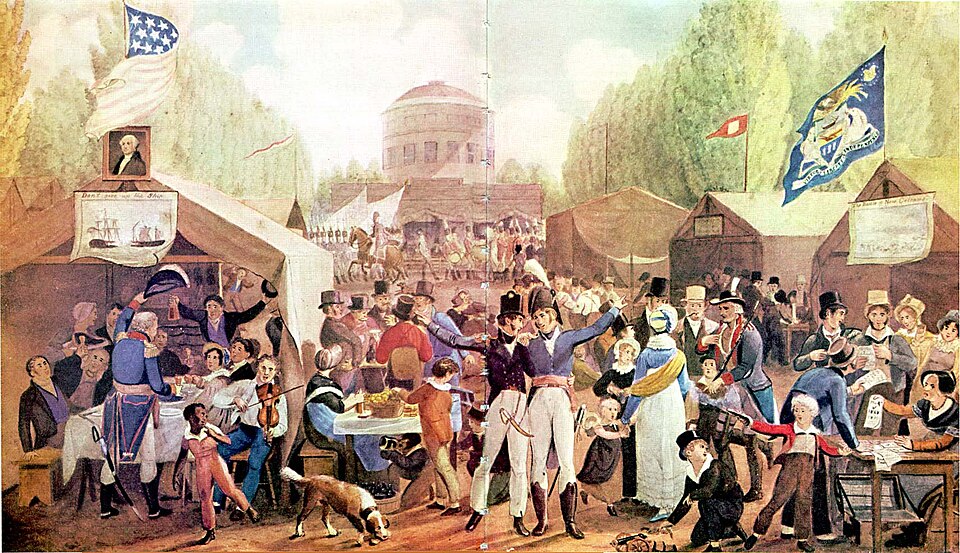
"Independence Day Celebration in Centre Square, Philadelphia" by John Lewis Krimmel (public domain)
The War of 1812 brought a surge of nationalism to the young country, and this is reflected in a newspaper report of the Independence Day celebrations in the federal capital. Columns of newsprint detailed the military parades, the reading of the Declaration of Independence in the chambers of the Capitol, a party at the President’s Mansion, and a long report of the toasts offered by political leaders. Read the primary source here. It was both a celebration of a historic event and a political moment emphasized by the day’s activities.
Activity:
Check out some historic toasts from the Fourth of July, and then invite students to write their own, reflecting things important to them this year. Raise a juice box or other kid-friendly drinks, and let students toast who or what from U.S. history inspires them.
Here’s to freedom and 250! (Pixabay)
Turning Points in 1863
The American Civil War (1861-1865) transformed the United States. Politically, it tested the interpretation of the Constitution for the perpetual union of the states and ushered in amendments to more fully realize the principle that “all men are created equal.” For the divided nation, the Fourth of July gave Union and Confederate soldiers a chance to reflect on history and interpret their own war in the hopes that their cause was the “true” one that the founders would have supported.
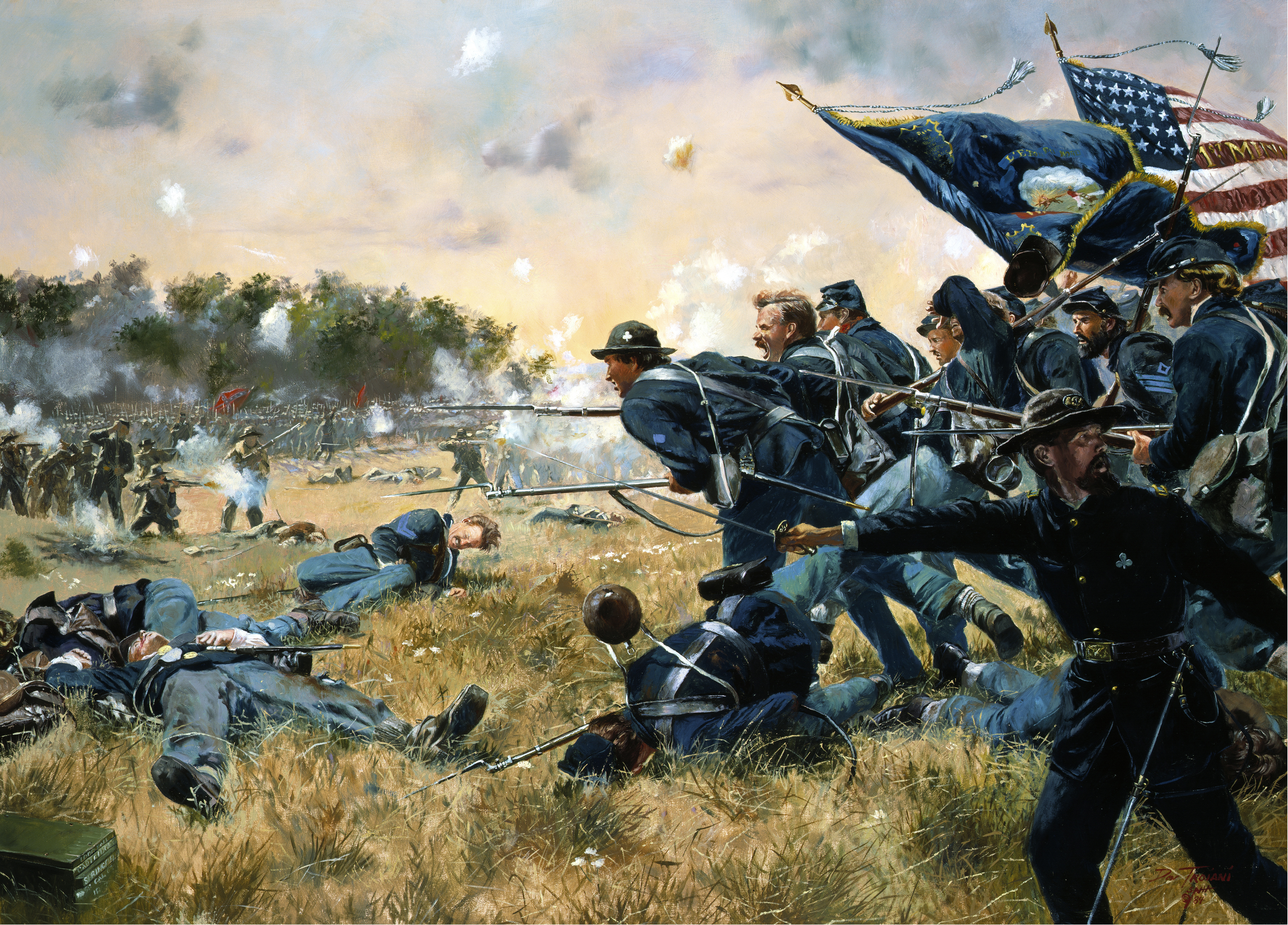
“The First Minnesota” at Gettysburg by Don Troiani, commissioned by the National Guard (Public Domain)
On July 4, 1863, Union soldiers in Pennsylvania and Mississippi realized they had won significant victories at Gettysburg and Vicksburg. These costly battles marked turning points. A three-day battle at Gettysburg ended with Union troops holding the high ground and the Confederates retreating. Vicksburg was the last Confederate stronghold along the Mississippi River, and it surrendered on July 4; years later General Ulysses S. Grant remembered the moment and holiday in his memoir. Though the war lasted nearly two more years, Independence Day 1863 marked an important moment in the nation’s pursuit of liberty and redefining freedom. Even in the moments of war, soldiers and civilians remember the Fourth of July, and some found reasons to cheer for victories and hope.
Activity:
Bulletin boards, posters, or classroom doors—the possibilities are many! Can your classroom or school enjoy a Spirit Day or Week to explore, celebrate and commemorate the 250th anniversary of the Declaration of Independence?
“as the great anniversary Festival” – John Adams (Public Domain)
Commemorating and Celebrating at 250
This year is 250 years since 1776. Across the country, communities gather to commemorate historic events or celebrate the strong ideals of our nation. It might be with a solemn reading of the Declaration of Independence, raising a glass to hopes for the future, fireworks bursting across the sky, and children cheering in anticipation for a show or parade. It’s a moment to learn and reflect, believe and celebrate. Happy 250th Anniversary of Independence in the USA!
Extra Activities:
Consider having students interview older family members or community leaders about their memories of the Bicentennial (1976). Or if interviews aren’t easily done or inclusive for all students, perhaps explore some online archives of Bicentennial photos, newspapers, etc., and discuss findings.
Check out free coloring pages of the state flowers or state birds. Let the classroom decorating or arts and crafts commence.
Create a classroom quilt or collage with paper or fabric. Find ideas here and here and here.
About the Author
Sarah Kay Bierle works as an education coordinator at the American Battlefield Trust, developing lesson plans and hosting professional development for teachers. She is thrilled to be part of the trust’s mission to preserve historic land, educate about history, and inspire future generations.
America at 250: From Revolution to Republic
This collection traces the nation’s journey from colonial life and growing resistance to British rule, through the Revolutionary War, the Declaration of Independence, and the creation of a new constitutional government. Organized thematically, the resources support instruction in U.S. history, civics, and ELA while encouraging inquiry, discussion, and critical thinking.
The American Battlefield Trust provides free K-12 educator resources covering America's first 100 years. We specifically focus on the Revolutionary War, War of 1812, and American Civil War eras. Our Civil War curricula for elementary, middle, and high school levels are aligned to both the National... See More