. Skip to main content
Discover Dairy & Milk Safety
lesson
30 Downloads
Write a review
beta
EdBrAIn It
EdBrAIn uses AI to customize lesson resources for your students’ needs.

Discover Dairy & Milk Safety

Share

Share On Facebook
Share On Twitter
Share On Pinterest
Share On LinkedIn
Email
Subject ScienceLife Science
Grade Level Grade 6
Standards Alignment
State-specific
License

About This Lesson

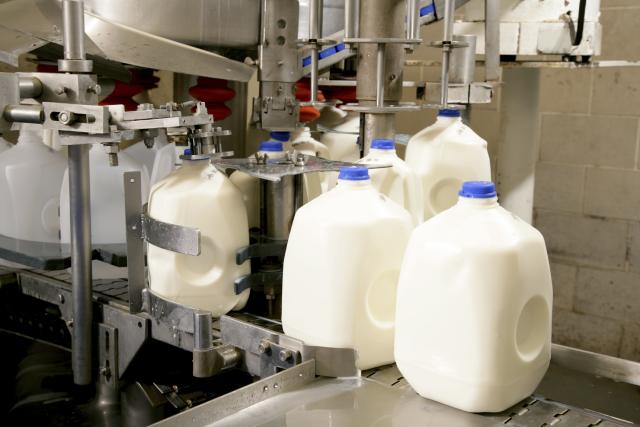
Do you know what goes into making sure the food we eat is safe? Milk is one of the most highly regulated and safest foods available. Milk and dairy foods must undergo a number of safety and quality procedures, such as pasteurization, to make sure they are safe and wholesome to consume. This lesson will discuss what steps milk must go through to ensure safety and how dairy products are made from milk. It will also highlight the chemistry that goes into making milk into different products like cheese, yogurt and ice cream. The lesson incorporates science and reading standards for 6th – 8th grade. Two science labs are also included – one on testing milk and another on making cheese.
Resources

Files

beta
EdBrAIn uses AI to customize lesson resources for your students’ needs.

09-14 UL Milk Safety Lesson Two.pdf

February 13, 2020
4.17 MB
Videos
Middle Milk Safety and Quality FINAL 7 14 1
Remote video URL

Standards

Explain how certain questions can be answered through scientific inquiry and/or technological design (e.g., consumer product testing, common usage of simple machines, modern inventions).
Use evidence to support inferences and claims about an investigation or relationship (e.g., common usage of simple machines).
Identify and analyze evidence that certain variables may have caused measurable changes in natural or human-made systems.
Processes, Procedures, and Tools of Scientific Investigations
Apply appropriate instruments for specific purposes and describe the information the instruments can provide.
Explain the parts of a simple system, their roles, and their relationships to the system as a whole.
Describe a system as a group of related parts with specific roles that work together to achieve an observed result.
Explain how components of natural and human-made systems play different roles in a working system.
Apply knowledge of models to make predictions, draw inferences, or explain technological concepts.
Explain that matter has observable physical properties.
Explain that materials are characterized by having a specific amount of mass in each unit of volume (density).
Describe that matter can undergo chemical and physical changes.
Agriculture and Society
Identify questions that can be answered through scientific investigations and evaluate the appropriateness of questions.
Design and conduct a scientific investigation and understand that current scientific knowledge guides scientific investigations.
Describe relationships using inference and prediction.
Use appropriate tools and technologies to gather, analyze, and interpret data and understand that it enhances accuracy and allows scientists to analyze and quantify results of investigations.
Develop descriptions, explanations, and models using evidence and understand that these emphasize evidence, have logically consistent arguments, and are based on scientific principles, models, and theories.
Analyze alternative explanations and understanding that science advances through legitimate skepticism.
Use mathematics in all aspects of scientific inquiry.
Understand that scientific investigations may result in new ideas for study, new methods, or procedures for an investigation or new technologies to improve data collection.
Identify how emerging agricultural technologies have an effect on ecosystem dynamics and human/ animal food resources.
Identify key aspects of manufacturing systems that use mechanical processes to change the form of natural materials (e.g., separating, forming, combining, conditioning).
Physical Science, Chemistry and Physics
Explain the parts of a simple system and their relationship to each other.
Describe a system as a group of related parts that work together to achieve a desired result (e.g., digestive system).
Explain the importance of order in a system.
Distinguish between system inputs, system processes and system outputs.
Explain scale as a way of relating concepts and ideas to one another by some measure.
Describe the effect of making a change in one part of a system on the system as a whole.
Explain and apply scientific and technological knowledge.
Answer “What if” questions based on observation, inference or prior knowledge or experience.
Apply process knowledge to make and interpret observations.
Conduct a two-part experiment.
Judge the significance of experimental information in answering the question.
Explain the value and uses of different earth resources (e.g., selected minerals, ores, fuel sources, agricultural uses).
Agriculture and Society
Explain the improvement of agricultural production through technology.
Explain the concepts of cycles.
Explain how people use natural resources.
Compare means of growing or acquiring food.
Identify fiber and other raw materials used in clothing and shelter production.
Define issues associated with food and fiber production.
Compare the technologies that have advanced agricultural production.
Develop questions that can be answered through scientific inquiry and/or technological design.
Use evidence such as observations or experimental results to support inferences.
Use evidence to develop descriptions, explanations, and models.
Processes, Procedures, and Tools of Scientific Investigations
Identify and explain the impacts of applying scientific, environmental, or technological knowledge to address solutions to practical problems.
Compare how a product, system, or environment developed for one setting may be applied to another setting.
Explore the design process as a collaborative endeavor in which each person in the group presents his or her ideas in an open forum.
Analyze how a multidisciplinary (STEM) approach to problem solving will yield greater results.

Reviews

Write A Review

Be the first to submit a review!

Advertisement