
About This Lesson
This series began with a question I asked Sudanese civilians during research for the first article, when the war in Sudan erupted in April 2023 and genocide was rapidly unfolding: what do you need from people outside the country? What can we realistically do?
The answers did not concern money, policy, or petitions. Instead, everyone answered the same way, and I think they would still today: talk about it.
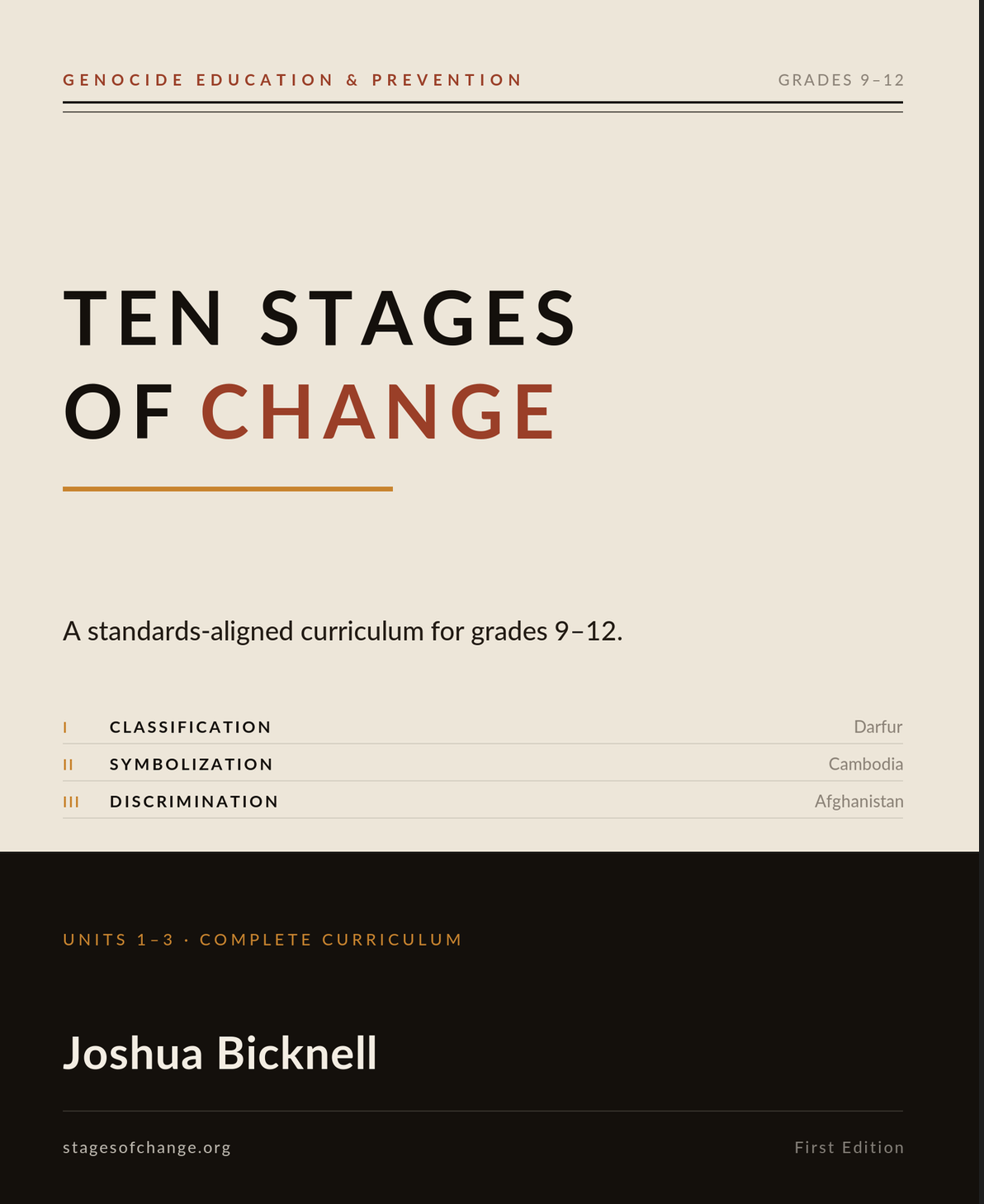
That instruction informs every page of this curriculum and its case studies. Gregory Stanton’s “Ten Stages of Genocide” serves as an analytical spine, crucial for recognizing that genocide develops as a process, predictable though never inevitable, and interruptible at every stage. hese units do not pretend the subject is easy. The anchor texts are direct and difficult, and the guidelines in this Series Guide ensure challenge never becomes harmful. The norms and breaks are part of the instructional design, not optional add‑ons.
And so is the conviction on which the project rests: ordinary people, especially students, have repeatedly interrupted this pattern and hold immense power to continue and to refuse to live in a society where cultural extermination is ever acceptable wherever it occurs.
Teaching one or more of these units invites students to be called, as Stanton was, as I was, as we all are; we have no choice. Some students will be called as well. In all its darkness, humanity remains beautiful.
Every anchor text closes with actions scaled to the time a reader actually has, because recognition without response stalls prevention. The killing in Sudan did not stop while this series was written. The krama is still worn. Girls in Afghanistan continue teaching one another in basements, whispering poetry and song between lessons.
‘Please find me,’ they say. ‘Please talk about it.’ So, let’s talk about it.