. Skip to main content
A colorful illustrated banner titled "Beyond Red and Blue: What New Survey Data Reveals About America," featuring a multicolored pie chart divided into nine segments representing distinct voter groups identified in a Pew Research Center survey.

American politics are more complex than a simple red-versus-blue divide. A new Pew Research Center survey of more than 10,000 people identified nine distinct political and cultural voter groups, finding that only a minority of Americans are fully committed to either major party.

Survey Reveals Political and Cultural Factions Shaping the Midterms

June 18, 2026

Survey Reveals Political and Cultural Factions Shaping the Midterms

Are you a Faith First Conservative? A Loyal Liberal? Part of the Tuned-Out Middle? A new Pew Research Center survey says American politics are way more complex than red versus blue, and the findings could reshape how candidates campaign ahead of the 2026 midterms.

Share

Share On Facebook
Share On Twitter
Share On Pinterest
Share On LinkedIn
Email

A new report from the Pew Research Center says American politics are not as simple as red versus blue. Pew surveyed more than 10,000 people and split the public into nine distinct groups along political and cultural values. Despite a polarized political environment, the report finds a minority of Americans are truly all-in for either party.

View the transcript of the story.

NOTE: If you are short on time, watch the video and complete this See, Think, Wonder activity: What did you notice? What did the story make you think? What would you want to learn more about? You can also make a Google doc copy of these general discussion questions.

Remote video URL

Warm-Up Questions

  1. Who is Jocelyn Kiley?
  2. What is the number of "tuned-out middle" voters who voted in 2024?
  3. Where have most Americans oriented themselves politically, based on the chart?
  4. Why have group names for Republicans and Democrats changed in the survey over the years?
  5. Why might some voters not identify strongly with either major political party, according Kiley?

Essential Questions

  • How do politicians use voter data like this Pew Research poll to appeal to different types of groups?
  • Do you think the American political landscape is more complex than a simple Democrat-versus-Republican divide? Why/why not?
  • Media literacy: Surveys can provide insights into public opinion, but they also have limitations. As you watched the video or read the poll, consider how researchers define categories such as "Faith First Conservatives" or the "Loyal Liberals." How might the wording of survey questions, i.e. the sample of respondents or the labels assigned to groups, influence how the public interprets the survey?

What Students Can Do

Step 1: Read the full Pew Research Center report.
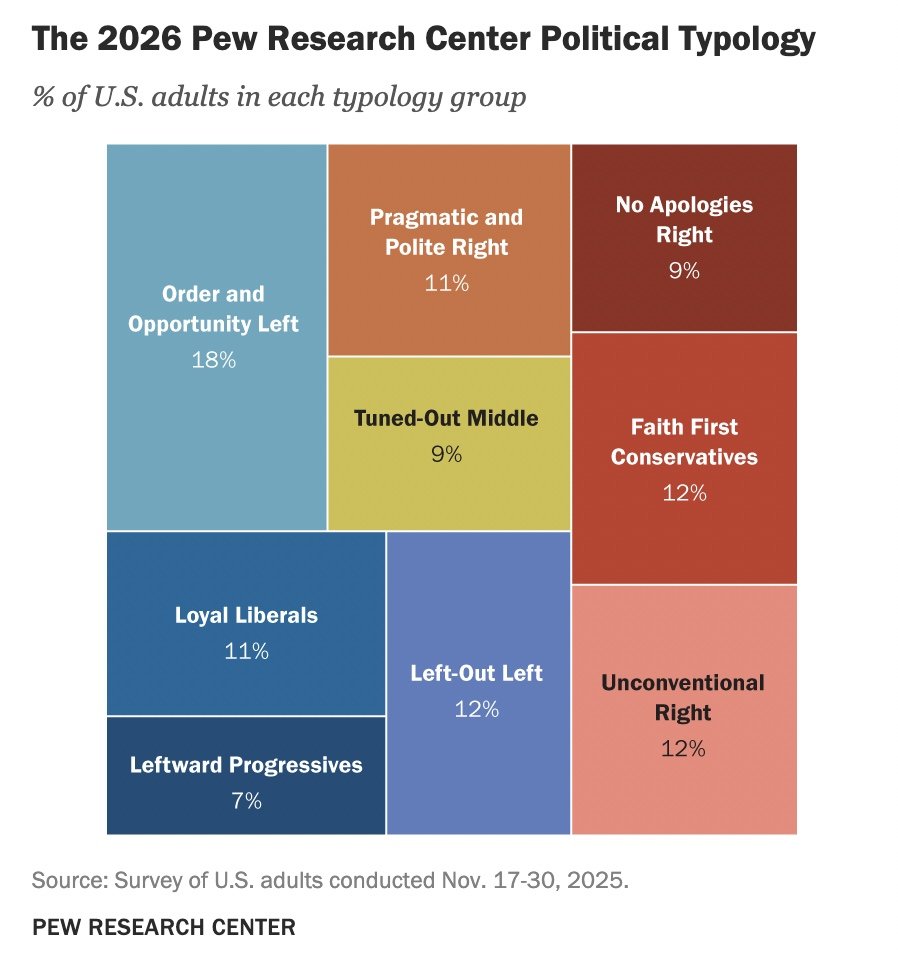
A Pew Research Center treemap chart titled "The 2026 Pew Research Center Political Typology" showing the percentage of U.S. adults in nine distinct voter groups, ranging from Order and Opportunity Left at 18% to Leftward Progressives at 7%. Source: Survey of U.S. adults conducted Nov. 17-30, 2025.

Step 2: Imagine you are advising a political candidate. Choose one of the voter groups discussed in the article and develop a campaign strategy to appeal to that group. What issues would you emphasize? What challenges might you face in attracting their support?

In your strategy, consider the following questions:

  • Which issues are most important to this group?
  • What messages or policy proposals would resonate with them?
  • What forms of outreach would be most effective (social media, television ads, town halls, community events, etc.)?

Present your strategy in the form of a campaign memo, advertisement, speech outline or presentation, and explain why you believe it would be effective.

2026 Election Lesson Plans and Resources


Explore our election resources to engage your students in learning about the election process and its significance at every level. Discover lessons on election fundamentals, laws, security, current events, youth involvement, and historic U.S. elections.

Republished with permission from PBS News Hour Classroom.

PBS News Hour Classroom
PBS News Hour Classroom helps teachers and students identify the who, what, where and why-it-matters of the major national and international news stories. The site combines the best of News Hour's reliable, trustworthy news program with lesson plans developed specifically for... See More
Advertisement

Post a comment

Log in or sign up to post a comment.