


Choosing Humanity in Divided Times
Jewish and Muslim leaders discuss rising antisemitism and Islamophobia, solidarity across differences, and how educators can foster empathy and respect.
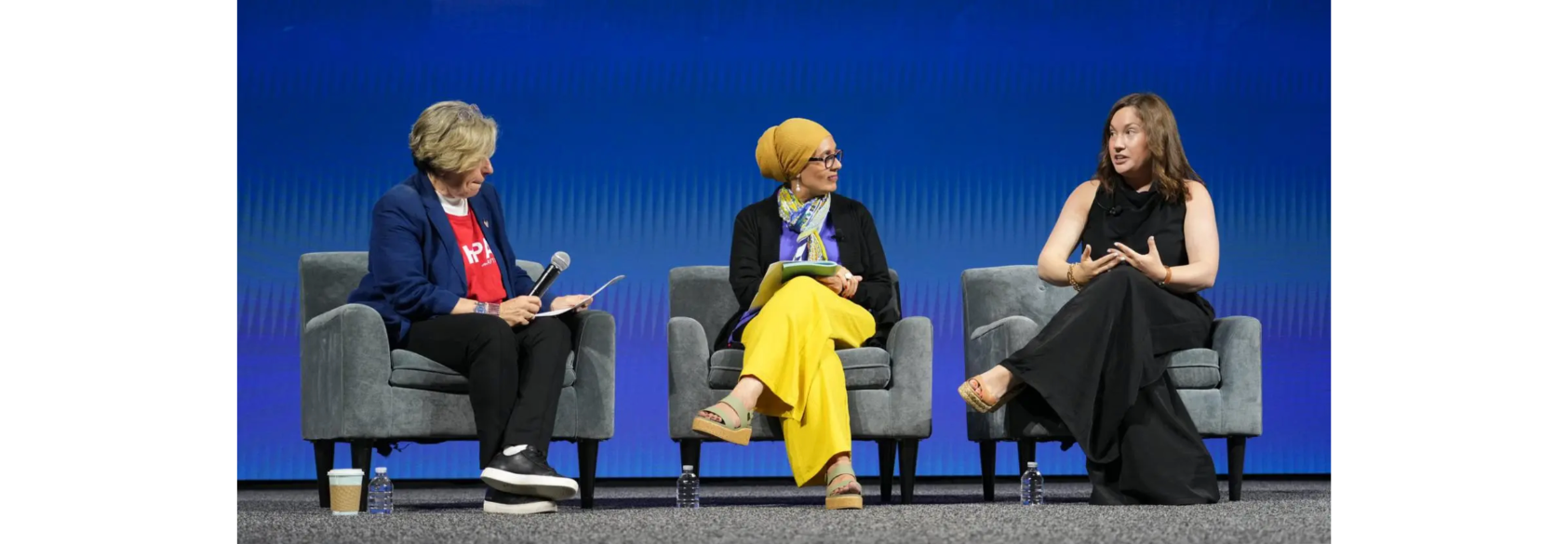
Photo credit: Suzannah Hoover
Share
August 24, 2026
Jewish and Muslim leaders discuss rising antisemitism and Islamophobia, solidarity across differences, and how educators can foster empathy and respect.
Share
By Melanie Boyer
As antisemitism and Islamophobia rise, and conversations about both are increasingly fraught, Jewish and Muslim leaders took the stage at the AFT convention with a shared message: Silence will not keep communities safe. Amy Spitalnick, CEO of the Jewish Council for Public Affairs, and Debbie Almontaser, founder and CEO of Bridging Cultures Group, joined AFT President Randi Weingarten for a candid discussion about hate, solidarity and how educators can create space for disagreement that builds empathy instead of deepening division.
“What we wanted to do today with this panel is to model a conversation across difference and even disagreement,” Weingarten said. “In the absence of these kinds of conversations—conversations around race, around political views, around religion, around geography—two things happen: We lose our skills to build connections. And … writ large, we become unable to see the humanity of others. And when this happens, the bonds—even bonds of people that used to be friends—just get destroyed.”
Silence will not keep communities safe.
For Spitalnick and Almontaser, the work of building connection is personal. They each spoke about family experiences with prejudice, migration and unexpected solidarity shaping their commitment to fighting hate.
Almontaser recalled that in the days following the Sept. 11, 2001, attacks, a rabbi invited her to his synagogue to help congregants identify concrete ways to support their Muslim neighbors. That visit led to an escort program in which Jewish congregants accompanied Muslim families to school, medical appointments and other destinations across New York City, offering protection and solidarity at a time when many were afraid to leave their homes.
Almontaser said she returns to that experience whenever another tragedy strains relations between communities. It reminds her, she said, that people can choose to show up for one another and help build a better world.
People can choose to show up for one another and help build a better world.
On a broader level, Spitalnick linked antisemitism to conspiracy theories that are used to divide communities. She referenced the damaging stereotypes of Jewish control in political and financial institutions, and the scare tactic of a great replacement theory. The latter showed its face during the 2017 Unite the Right rally in Charlottesville, Va., which was dominated by chants of “Jews will not replace us.”
Countering that narrative starts with recognizing individuals, Spitalnick said. She pointed to the current situation in the Middle East and reminded delegates that not all Jews and Israelis agree with the Israeli government and that many actively protest against its actions.
Weingarten closed the panel by sharing resources for educators to conduct similar conversations in their own classrooms, pointing out that even though we have differences, there is always room for respect.
Republished with permission from AFT.
Explore classroom-ready lessons that help students understand antisemitism, examine current events, and build respectful, inclusive communities.
This collection represents more than a tool for educators: it reflects the growing recognition that education can help our children learn about the full scope of America's racial history and its continuing impact. As we strive to build a more inclusive and compassionate society, equipping our young people with the knowledge, understanding, and empathy to face these complex issues head-on is not only wise but also vital.


