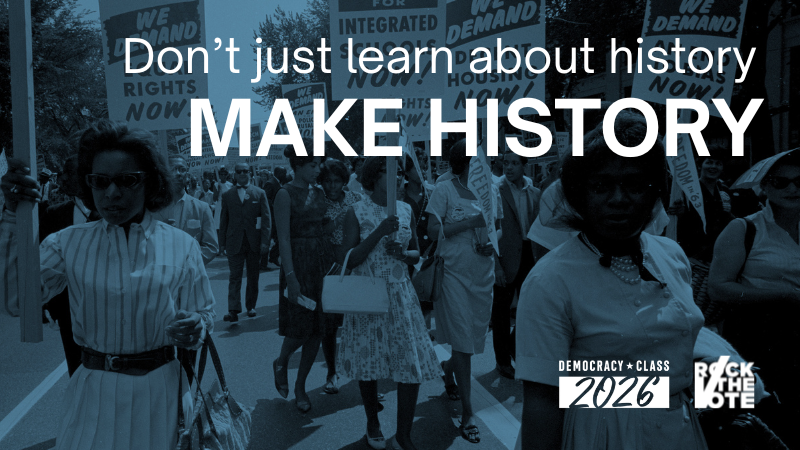
One of my personal favorite activities is the human timeline. Instead of simply memorizing amendments, students physically explore the broader history of voting rights—including the many ways voting laws can change and the people and movements that have pushed those changes forward.
The activity helps students see that the expansion of voting rights in the United States hasn’t always been smooth, and it hasn’t always been easy. Throughout our history—and in the present day—Americans have fought to expand access to the ballot and protect the right to vote.
That history gives students an important foundation for understanding the elections and voting policies they encounter today.
What happens when we look at who votes?
One question we can ask students is deceptively simple: Who participates in local elections?
The answer can tell us a lot about whose voices are represented in election results.
In Democracy Class Lesson 2: Not Just Every Four Years, students can now explore that question using Rock the Vote’s new Who Decides? tool. The tool allows students to compare voter turnout among people ages 18–29 and people ages 30+ in cities across the country.
That comparison opens the door to a much bigger conversation.
Local elections affect things students encounter every day—from schools and transportation to housing and other local services. By examining who is and isn’t showing up to vote, students can think critically about how differences in turnout, including differences among young voters, can shape who has a voice in local decision-making.
For me, that’s what makes civic education so meaningful. It’s not just about memorizing how elections work. It’s about helping students see the connection between participation and the decisions that affect their everyday lives.
What voting rights do young people have in your state?
Through Democracy Class, students can also explore another important question: How do voting policies affect young people’s access to the ballot box across the country?
Democracy Class Lesson 2: Not Just Every Four Years now incorporates Rock the Vote’s State Voting Rights Snapshots, a new tool designed to make complex election policies easier for students to understand and connect to their own lives.
Rock the Vote partnered with the Movement Advancement Project (MAP) to track state-level election policies that shape young people’s ability to cast a ballot. Using MAP’s data, these policies have been translated into easy-to-understand, state-by-state snapshots that categorize states as Leaders, Slackers or Blockers of youth voting rights.
For teachers and students, the snapshots provide a starting point for exploring how election policies can influence young people’s experiences with voting. They also give students an opportunity to connect the policies they’re studying with the real-world process of participating in our democracy.
Preparing the Next Generation of Voters
I believe one of the most important things we can do for the next generation is give them the opportunity to understand democracy before they’re asked to participate in it.
The students sitting in classrooms today will become tomorrow’s voters, community leaders, advocates and engaged citizens. Some will vote for the first time this year. Others won’t cast their first ballot for several more years. But all of them can begin learning now.
That’s why I believe civic education belongs in every school. By giving students opportunities to explore elections, voting, participation and informed decision-making, we can help equip them with the knowledge they need to understand—and take part in—the democratic process.
Join Rock the Vote’s Democracy Class Coalition
The future of our democracy is already sitting in our classrooms. Let’s make sure students have the knowledge they need to participate when their time comes.
All of the resources described above are now available as part of Democracy Class, making it easy to bring civic learning into your classroom or community.
You can download the materials on Share My Lesson or sign up as a partner on the Rock the Vote website. As part of the 2026 Democracy Class Coalition, we’ll send you everything you need to bring Democracy Class to the students and communities you serve.
Thank you for helping prepare the next generation to become informed, engaged participants in our democracy.


