
About This Lesson
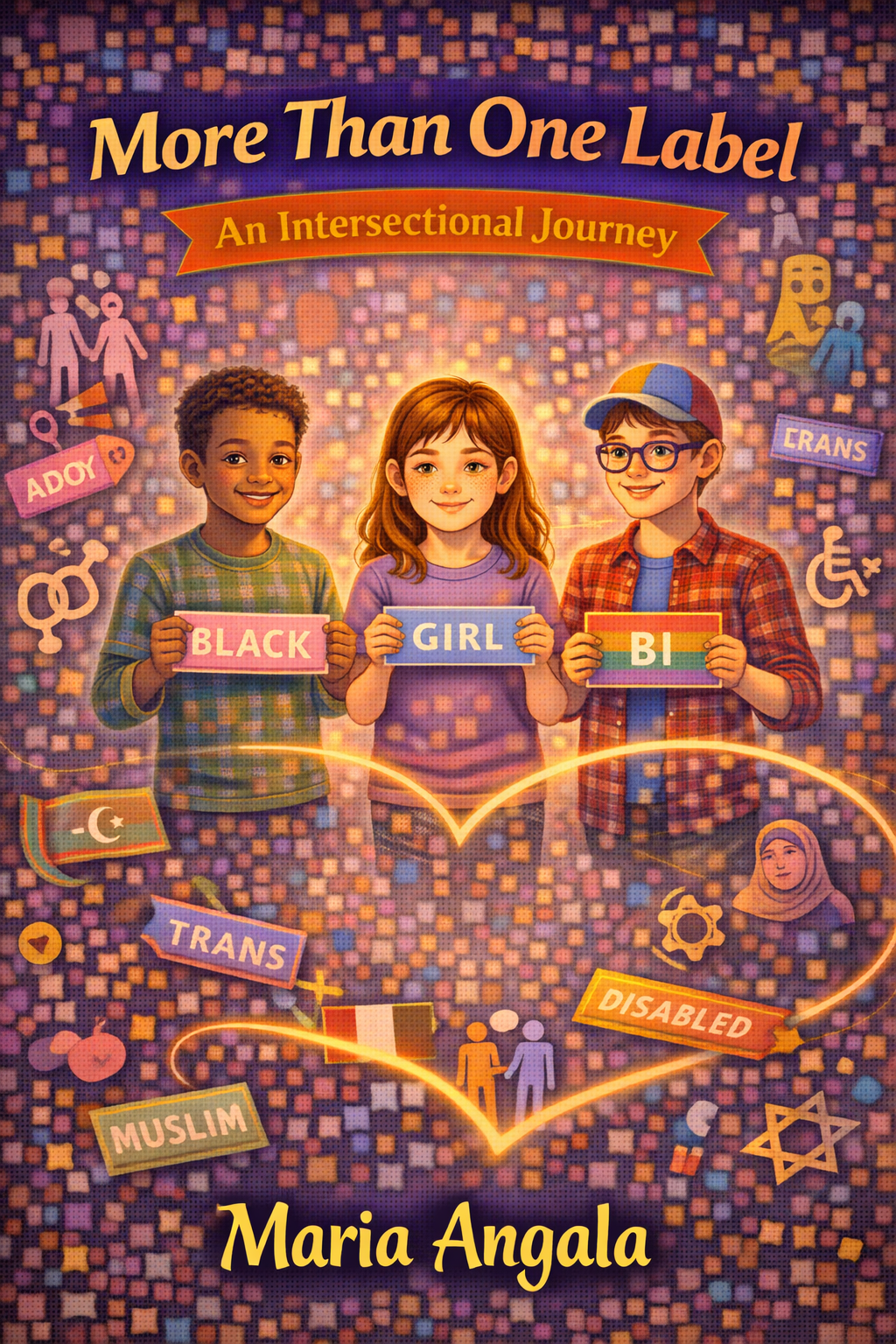
Audio Link: eBook "More Than One Label" by Maria Angala, NBCT: An Intersectional Journey | Intersectionality Lesson for Middle School ELA and SEL
Here's the thing about intersectionality—most kids are living it every day without having a single word for it.
Zari does. She's a Black girl who uses a wheelchair, and she's spent her whole life watching people see exactly one part of her at a time. The teacher sees "girl." The coach sees "wheelchair user." Nobody sees Zari. Until her Grandpa pulls out a box of markers and draws three overlapping circles—and suddenly everything clicks.
That's the moment this lesson is built around. And it lands every single time.
What does intersectionality actually mean for a middle schooler?
It means your identities don't take turns. They all show up at once, in every room, every day—and they interact with each other in ways that shape your whole experience. A Black girl with a disability doesn't just face "race stuff" sometimes and "disability stuff" other times. She faces both simultaneously, in ways that are completely unique to that combination.
That's a concept most adults struggle to articulate. This story explains it to a 6th grader in under ten pages. Using Venn diagrams, a "Girls in Science" camp that wasn't actually built for all girls, and a friendship between two kids who immediately recognize each other as living in the middle of the circles.
It works because it's specific. Not abstract theory. Just Zari. Just Sam. Just the tables that were too high and the videos without captions—and two kids who decided to say something about it.
What's inside:
A complete illustrated reading passage (9 pages) following Zari's intersectional journey, plus a Professional Planning Partner Note structured for 50-minute Literacy and SEL blocks. Differentiated for Level 1, 2, and 3 learners. Print-ready and Easel by TpT compatible.
The "Circle Challenge" warm-up is deceptively powerful—list three labels you have. Where do they overlap?—and it opens up conversations teachers often don't realize their students need. The classroom app accessibility activity in the "We Do" section is genuinely creative: students audit a tool they already use and ask whether it actually works for everyone in the room. That's real-world critical thinking, not worksheet fill-in.
And the metacognitive Level 3 prompt—how do your labels work together to make you a strong student?—reframes identity markers as strengths. Not burdens. Not boxes. Bridges.
Who this is built for:
Middle school ELA and SEL teachers, especially in inclusive or co-taught classrooms. Special education teachers working on identity and self-advocacy. School counselors running belonging or social justice units. Any educator whose students include wheelchair users, deaf or hard of hearing students, multilingual learners, or kids from multiply-marginalized backgrounds—which, again, is basically everyone.
This pairs perfectly with Out of My Mind, El Deafo, Wonder, Front Desk, or any unit centered on disability representation, identity, or social justice. Also works as a standalone anchor before a persuasive writing unit on equity and inclusion.
Why this one is genuinely different:
Most "diversity" resources teach kids to be nice to people who are different. This one teaches something harder and more important: that systems—not just individuals—can fail to see the whole picture. Zari doesn't just make a new friend. She advocates for structural change at a science camp. And she does it with data, with clarity, and with a friend beside her.
That's the kind of civic literacy that actually transfers beyond the classroom.
The disability representation here is also handled with real dignity—Zari is sharp, funny, socially aware, and completely three-dimensional. She's not the lesson. She's the protagonist. Big difference.
Get FREE resources for your SPED & multilingual learners!
✯ Earn TpT credits (and save money!) Did you know you earn credits toward future purchases when you leave feedback? Go to your “My Purchases” page and click “Provide Feedback” next to any resource. Share a quick rating and comment—it helps me continue creating meaningful supports for students who need it most.
💡 Your feedback = more targeted FREE resources for your classroom 💡 Your credits = savings on future purchases
Win-win!
Stay connected for more FREE ACCESS resources:
✯ Click the ⭐ “Follow Me” button at the top of my store. When you follow, you’ll be the first to know when I post:
- FREE literacy supports for struggling readers
- SPED & ELL scaffolds you can use right away
- New ACCESS-aligned resources and updates
Standards alignment: CCSS ELA RL and RI strands for grades 6–8, including theme, character development, and informational text analysis. Strong alignment with CASEL SEL competencies—self-awareness, social awareness, and responsible decision-making. Connects to civics, health, and social studies standards around equity and access.
TAGS: intersectionality lesson middle school, identity and belonging ELA activity, disability representation reading passage, Black girl wheelchair user story, social justice reading passage grades 6 8, SEL identity lesson intersectionality, inclusive classroom reading activity, differentiated ELA passage middle school, multiple identities lesson plan, diversity equity inclusion reading unit, Venn diagram identity activity, disability awareness lesson ELA, multicultural literature middle school, belonging and identity SEL lesson, social justice for kids reading passage
⭐ Neurodiversity-aligned, Low-prep and Scaffolded for IEPs.
🔥Join our growing FUNSHINE community: BilingualSPED.com