
About This Lesson
Audio Link: eBook "The Spectrum of Us" by Maria Angala: A Queer Intersectional Romance | LGBTQ+ and Autism Representation Reading for High School ELA and SEL
This one is for the students who have never once seen themselves in a school reading passage.
Not the gay kid in the background. Not the autistic character who exists to teach the neurotypical protagonist something. Not the non-binary person who gets three lines and a pride flag. Deo'Vae and Kai. Center of the page. Center of the story. Whole, specific, complex, and seen.
Here's what this story is actually about:
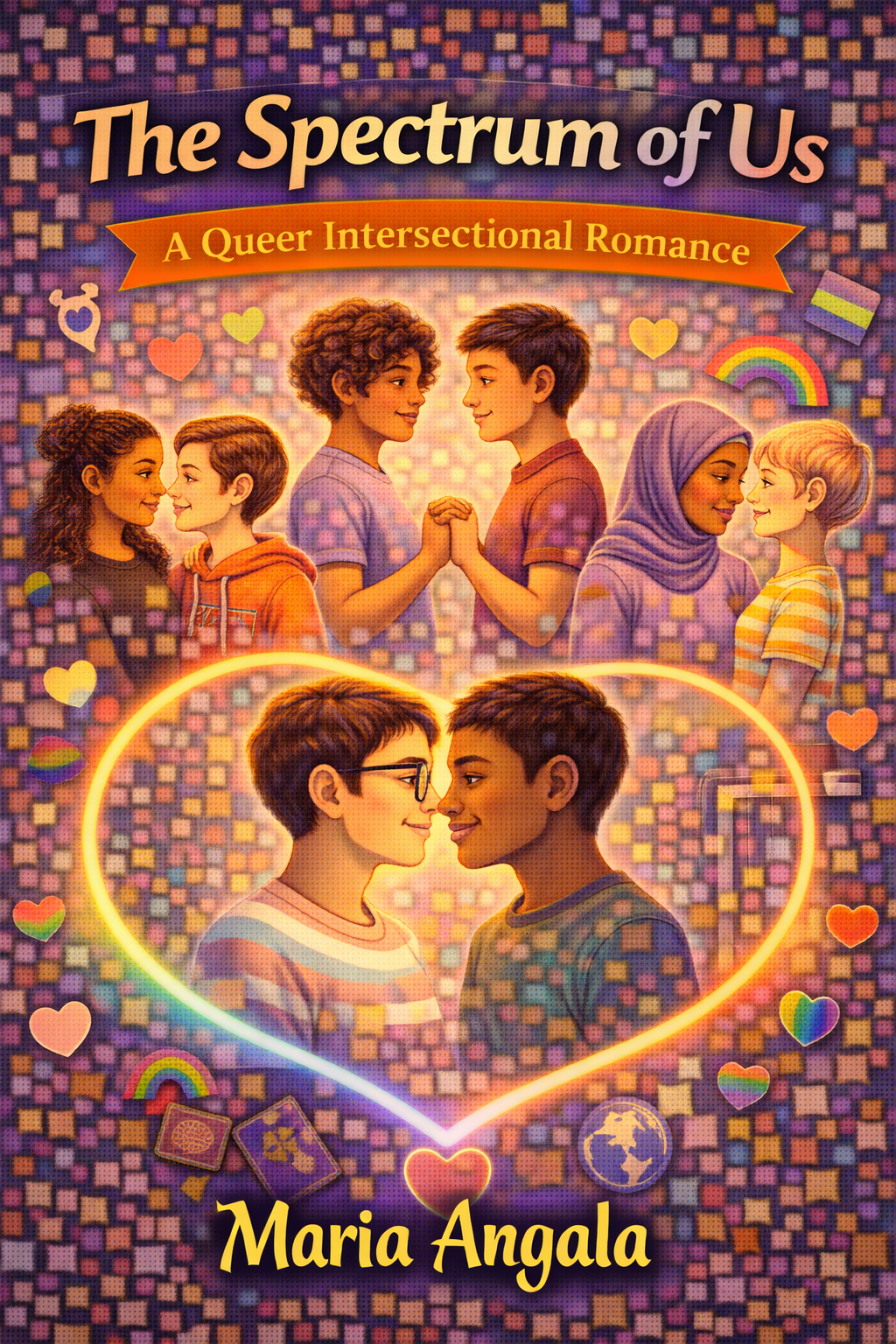
Deo'Vae sees the world in patterns. He's autistic—which the story describes, quietly and beautifully, as having a brain like a high-definition camera. He notices dust dancing in sunlight. He notices the exact rhythm of the school's air conditioner. And then he notices Kai—a Japanese-American, non-binary student whose laugh sounds like a song played on a wooden flute.
Their relationship doesn't follow the movie script. No loud parties. No crowded dances. Those are "Too Loud" for Deo'Vae's brain and "Too Gendered" for Kai's heart. Instead they walk in the park, sit by a lake with shared headphones and soft lo-fi beats, and have a conversation about what it means to exist in the middle of your own interlocking circles—being seen as too many things at once and not enough of any of them.
That conversation is the lesson. And it's one of the most honest things in this entire series.
What makes this story genuinely rare:
Most LGBTQ+ classroom resources treat queerness as the only identity that matters in the story. This one holds multiple identities simultaneously—autism, queerness, race, and non-binary gender—without flattening any of them. Deo'Vae isn't just "the autistic kid." Kai isn't just "the non-binary kid." They're people whose identities intersect in ways that shape how they love and what they need from a relationship.
The "We don't have to follow the old script" moment is the kind of line that gets quietly underlined by students who've spent their whole lives watching romance narratives that had no room for them. Deo'Vae and Kai don't try to fit into the festival. They find the Slow Zone by the lake and build something that actually fits who they are.
That's not just representation. That's permission.
What's inside:
A complete illustrated reading passage (9 pages) following Deo'Vae and Kai's intersectional romance, plus a Professional Planning Note built for 50-minute English and SEL blocks. Structured for Pride Month or any "Modern Narratives" unit. Differentiated for Level 1, 2, and 3 learners. PDF and Easel by TpT compatible. Zero prep.
The "Circles of Me" warm-up—if you had three circles for your identity, what would they be? Where do they overlap?—is accessible to every student regardless of whether they identify as LGBTQ+ or autistic. It opens the intersectionality conversation through personal reflection rather than performance. The "Sensory Friendly Social Script" activity in the "We Do" section is genuinely creative and surprisingly practical—students brainstorm what a first date would look like if it was designed around actual needs rather than social expectations.
And the Level 3 metacognitive prompt connects queer intersectionality to workforce readiness—how does understanding intersectionality help you work with people from different backgrounds?—which is the kind of rigorous, transferable thinking that justifies this text to administrators who might raise an eyebrow at the cover.
Who this is built for:
High school ELA teachers building diverse YA reading units, especially during Pride Month or a Modern Narratives/Identity unit. Special education teachers whose students include autistic learners who are also navigating LGBTQ+ identity—a population that is, research consistently shows, significantly overrepresented in both communities. School counselors running SEL units on identity, belonging, and relationships. Any educator whose students include queer, non-binary, or neurodivergent kids who have never once been the protagonist.
Pairs naturally alongside They Both Die at the End, Aristotle and Dante Discover the Secrets of the Universe, On Earth We're Briefly Gorgeous, I'll Give You the Sun, or any LGBTQ+ YA anchor text. Also works as a standalone piece in any intersectionality unit.
A note on classroom use:
This resource handles its subject matter with genuine care and age-appropriate warmth. The romance is tender and quiet—shared headphones, a shoulder tucked against another shoulder, two people sitting by a lake. Nothing explicit. Nothing performative. Just two humans being whole together. That's the story.
Get FREE resources for your SPED & multilingual learners!
✯ Earn TpT credits (and save money!) Did you know you earn credits toward future purchases when you leave feedback? Go to your “My Purchases” page and click “Provide Feedback” next to any resource. Share a quick rating and comment—it helps me continue creating meaningful supports for students who need it most.
💡 Your feedback = more targeted FREE resources for your classroom 💡 Your credits = savings on future purchases
Win-win!
Stay connected for more FREE ACCESS resources:
✯ Click the ⭐ “Follow Me” button at the top of my store. When you follow, you’ll be the first to know when I post:
- FREE literacy supports for struggling readers
- SPED & ELL scaffolds you can use right away
- New ACCESS-aligned resources and updates
Standards alignment: CCSS ELA RL strands for grades 9–12, including character development, theme, and complex narrative analysis. Strong CASEL SEL alignment—self-awareness, social awareness, empathy, and responsible decision-making. Connects to health and psychology standards around identity development, neurodiversity, and gender.